
As the traffic dividend fades in recent years, customer management has become a new focal point for brands and marketers. This includes integrating multi-channel sources to build a 360-degree customer profile and providing automated and personalized marketing experiences. According to Adobe's 2023 survey, 47% of brand leaders reported that using a Customer Data Platform (CDP) has strengthened their relationship with customers; 42% indicated that the CDP has increased synergy between marketing and IT teams; and 32% believed that adopting a CDP has more effectively improved their return on investment.
However, each enterprise has different CDP needs based on its organizational structure, business stage, and digital maturity. The international authority on CDPs, the CDPI (Customer Data Platform Institute), suggests that there are various ways to implement a CDP. OmniSegment CDP by beBit TECH, with its superior product capabilities, has been certified by the CDPI and recognized as a member of the 2023 Advisory Board and a Gold Sponsor in the Asia-Pacific region. In this article, beBit TECH will share key evaluation points that brands must consider when selecting and implementing a CDP.
Enhancing Brand Data Utilization Efficiency through CDP Implementation
A CDP (Customer Data Platform) integrates multiple data sources, offering personalized experiences and real-time capabilities. By combining traditional CRM's operational data (O-Data) with anonymous experience data (X-Data) from browsing behaviors, a CDP can comprehensively collect both strong and weak signals from customer behavior footprints. This allows for labeling, segmentation, analysis, and communication, enabling marketers to precisely understand customer profiles and seamlessly conduct personalized marketing communications, thereby enhancing revenue efficiency.
The depth of a brand's understanding of customer profiles depends on the maturity of front-end data integration and analysis. In the data processing workflow, essential steps include data collection, cleansing, storage, matching, integration, and analysis, which test the technical and service capabilities of the CDP provider. Through these steps, marketers can identify consumer habits and preferences to more accurately execute marketing strategies.
Introduction to Three Common CDP Implementation Approaches
According to the Customer Data Platform Institute (CDPI), there are currently three common CDP implementation approaches in the market: building an in-house CDP, purchasing third-party software as a service (SaaS), and procuring single modules.
- Building an in-house CDP: This allows enterprises to develop the system based on their specific needs and strategies, providing full control over their data. However, this approach comes with high development difficulty, a long development timeline, challenging system maintenance, and the inability to keep up with new feature iterations. As a result, it is best suited for organizations with substantial technical resources and long-term business planning.
- Purchasing Third-Party Software as a Service (SaaS): This offers the advantages of a mature product, high implementation feasibility, low maintenance costs, and continuous feature updates. However, it also entails fixed subscription costs, potential security risks, and high dependency on the service provider. It is crucial to choose a CDP with ISO 27001 and ISO 27018 certifications for security assurance. Usability is another critical factor; CDPs with No-Code or Low-Code capabilities enable marketers to quickly extract and validate data, enhancing customer management efficiency and facilitating highly personalized marketing. This approach is ideal for organizations with limited development capabilities, technical teams focused on other priorities, or those needing immediate CDP services.
- Procuring Single Modules: This allows for high flexibility and cost savings on development, but also comes with functional limitations, performance constraints, integration challenges, high maintenance costs, and potential security risks. This approach is suitable for organizations with clear objectives, strong cross-departmental data and application management, comprehensive technical resources and teams, and robust development capabilities.
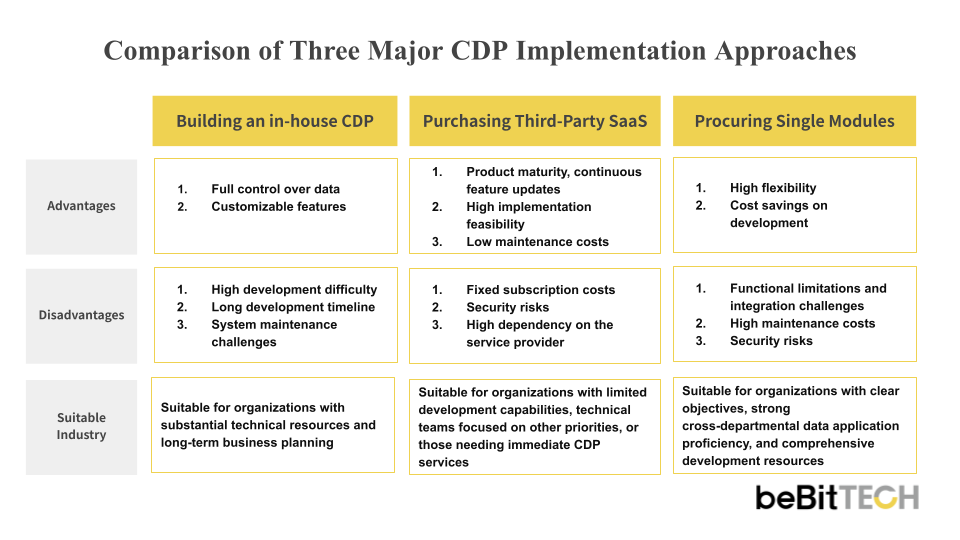
When selecting a CDP solution, enterprises need to consider their own needs and capabilities, while weighing the advantages and disadvantages of different options. Large enterprises, in particular, need to account for more complex scenarios when adopting a CDP. For instance, they need to handle vast amounts of data, manage complex system integrations, facilitate cross-departmental collaboration between usage and evaluation units, and even manage cross-border operations. Additionally, enterprises must consider how to integrate the CDP with existing systems such as CRM and ERP to achieve more comprehensive customer management.
Recommended SaaS CDP: OmniSegment
OmniSegment CDP, a product by beBit TECH, not only integrates various data sources seamlessly but also offers excellent scalability to meet the demands of processing large volumes of data. In terms of automated marketing channels, it supports SMS, EDM, LINE, Messenger, App-push, Web-popup, and more, all through No-Code customer journey design for automated and personalized marketing and communication. Additionally, OmniSegment CDP features multi-language support and the ability to handle cross-border operations, assisting enterprises in navigating different languages and cultural challenges. Furthermore, OmniSegment CDP can integrate with existing platforms, such as proprietary e-commerce systems, CRM, and ERP, enabling more comprehensive customer management. This makes it not only the most recognized CDP in e-commerce, but also a preferred choice for many retailers advancing their OMO (Online-Merge-Offline) strategies.
Conclusion
Overall, CDP technology has become a crucial trend that marketers must pay attention to. Enterprises can consider various options for utilizing a CDP, selecting the solution that best fits their needs and capabilities. For large enterprises or brands that prioritize customer management, OmniSegment CDP is a highly recommended choice. It helps brands achieve more comprehensive customer management and move towards sustainable business growth.