
Digital advertising costs are skyrocketing. You've increased your ad budget to attract new customers, but you're left wondering why these potential buyers aren't completing their purchases. At the same time, your e-commerce site's member data and offline orders are stored in different systems, and without a data analyst to help integrate these information, you're stuck with a bunch of member and order data that you don't know how to analyze. To make matters worse, the cost of acquiring new customers is rising, and your churn rate is not getting any better... If these challenges sound familiar, it's time to spend just 5 minutes learning how a Customer Data Platform (CDP) can help your brand overcome these marketing obstacles.
Three Reasons Your Brand Needs a CDP
Comprehensive Integration of Customer Data: Get a Complete View of Customer Profiles
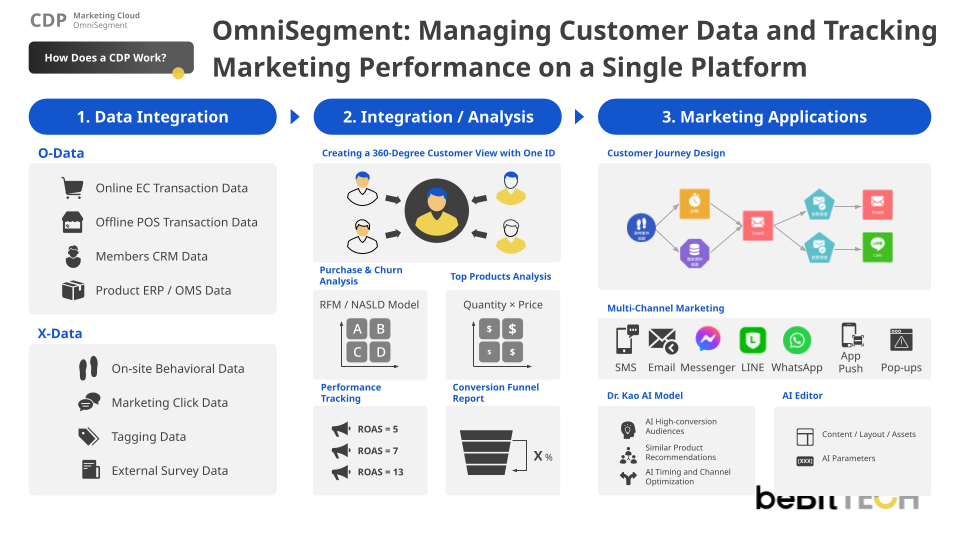
A common challenge brands face today is fragmented customer data, with customer details and order information scattered across various platforms. Consolidating data from CRM systems, e-commerce platforms, offline orders, and LINE into a cohesive view is a time-consuming task that tests the analytical skills of marketing teams. A Customer Data Platform (CDP) effectively resolves this issue by seamlessly integrating online EC orders, offline POS orders (O-Data, or Operational Data), and website behavior, along with data from various marketing platforms (X-Data, or Experience Data). This creates a unified, powerful, real-time customer database.
Easy and Flexible Market Segmentation to Accurately Target High Lifetime Value Customers
While integrating member data is a significant primary step, the core of customer management lies in segmentation. Identifying general customers versus those who contribute the most to your brand's revenue is crucial. High lifetime value customers typically exhibit high loyalty, frequent purchases, and higher average order values than the average. These are the customers with the highest Customer Lifetime Value (CLTV). A CDP's strength lies not only in data integration but also in its ability to effortlessly identify your high-value customers by analyzing purchase frequency, timing, and amount. This saves you from the tedious task of manually downloading and comparing order data from various platforms each month and allows for precise reanalysis of your brand's CLTV.
Creating Personalized Customer Experiences to Enhance Customer Lifetime Value
A CDP's powerful capabilities go beyond data analysis; it can also help brands enhance Customer Lifetime Value (CLTV). Typically, increasing CLTV involves boosting the frequency and value of customer purchases. However, this doesn't mean brands should spend heavily on broad marketing campaigns or frequently send mass marketing messages to existing customers. Instead, the focus should be on personalizing customer journeys that ensure natural interactions between the brand and the customer, creating more shopping scenarios and opportunities for them to make purchases. A CDP can analyze customer behavior on your website and their usage habits across different channels to design personalized customer journeys. This personalization enhances repeat purchase rates and boosts CLTV.
In addition to increasing repeat purchase rates, cross-selling and value-added services are effective ways to increase CLTV. By analyzing customers' historical purchase behavior, a CDP can help create automated cross-selling customer journeys. It can recommend the most relevant products at the optimal time, increasing the variety of products customers purchase.
Evaluating the Best Time to Implement a CDP
Is your brand ready to implement a CDP? To ensure the best results post-implementation, evaluate your readiness across these three key areas:
- Business Strategy: CDPs offer a wide range of functionalities, so understanding your brand's specific goals for implementation is crucial. Consider which CDP use cases are most relevant to your current customer management objectives. Select 1-2 use cases that would have the greatest impact on your business performance to focus on as you begin.
- Data Readiness: A CDP integrates first-party and third-party data, and its value increases with the completeness of this data. Ensure that your current CRM system, e-commerce platform, and third-party delivery platforms have well-maintained, comprehensive data. Also, verify that these systems have previously integrated with your chosen CDP provider to streamline the integration process and reduce implementation time.
- Mindset: Finally, be prepared to break traditional boundaries! Implementing a CDP requires collaboration across multiple departments and shared data usage. A common challenge is that online and offline sales are often managed by different departments, which can lead to conflicts in performance attribution post-CDP implementation. Therefore, adopting a CDP is not just about the technology; it's about the brand's commitment to marketing automation and a unified approach to customer data.
Why Do Brands Need a CDP When They Have CRM and DMP?
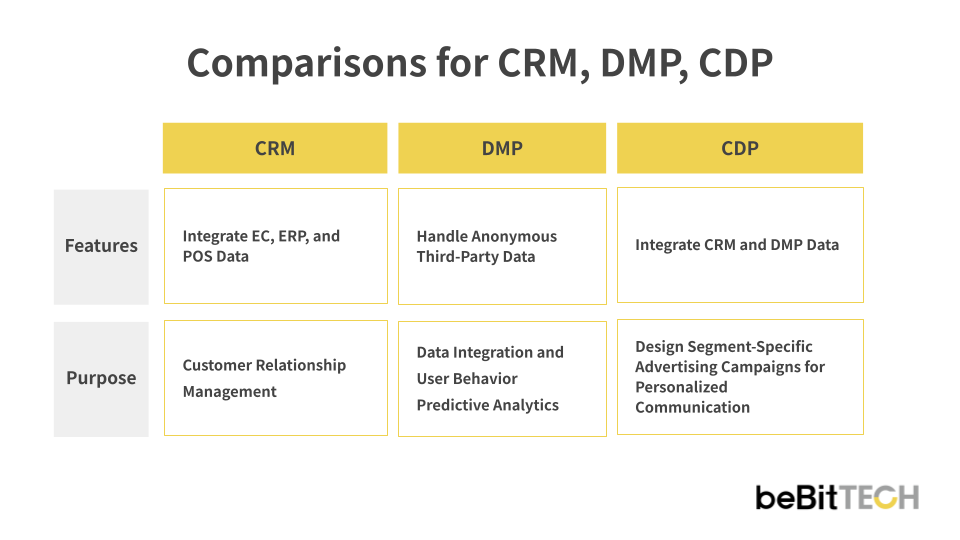
In the market, you often hear about brands using Customer Relationship Management (CRM) systems and Data Management Platforms (DMPs). The emergence of Customer Data Platforms (CDPs) is not meant to replace these data platforms but to complement them by addressing gaps in customer data analysis and enhancing marketing automation capabilities.
- CRM: Collecting Sales and Marketing Data
CRM systems are designed to manage customer relationships by collecting and organizing sales and marketing data. A CDP can receive data from a CRM and integrate it with other data sources within the brand, such as e-commerce platforms (EC), Enterprise Resource Planning (ERP) systems, and Point of Sale (POS) systems. This integration builds a more complete customer profile and extends personalized, automated marketing communications.
- DMP: Managing Anonymous Advertising Data
DMPs and CDPs have similar functionalities, but DMPs are primarily designed to handle anonymous data, with limited data retention periods, and are specialized for segmenting audiences for advertising campaigns. CDPs can match customer IDs in DMP data with first-party and third-party data from the brand, integrating both on-site and off-site consumer behaviors. This comprehensive approach allows brands to create more effective marketing strategies.
Conclusion
As third-party cookies are set to be phased out by 2024, the importance of CDPs has become more pronounced, particularly in markets like Europe and the U.S., where customer data privacy is highly valued. While Taiwan is still in the growth stage of CDP adoption, there has been a rapid increase in brand inquiries and adoption rates over the past two years. This trend suggests that the use of first-party data, combined with third-party data, will significantly expand in the near future. The information in this article may not apply universally to CDP strategies across all industries. It is recommended to consult directly with CDP service providers to understand how a CDP can be customized to address specific marketing challenges in your industry. If you are interested in learning more about OmniSegment, feel free to click on the Contact Usbutton to get in touch with our team for personalized assistance.