The short answer: data quality beats model choice
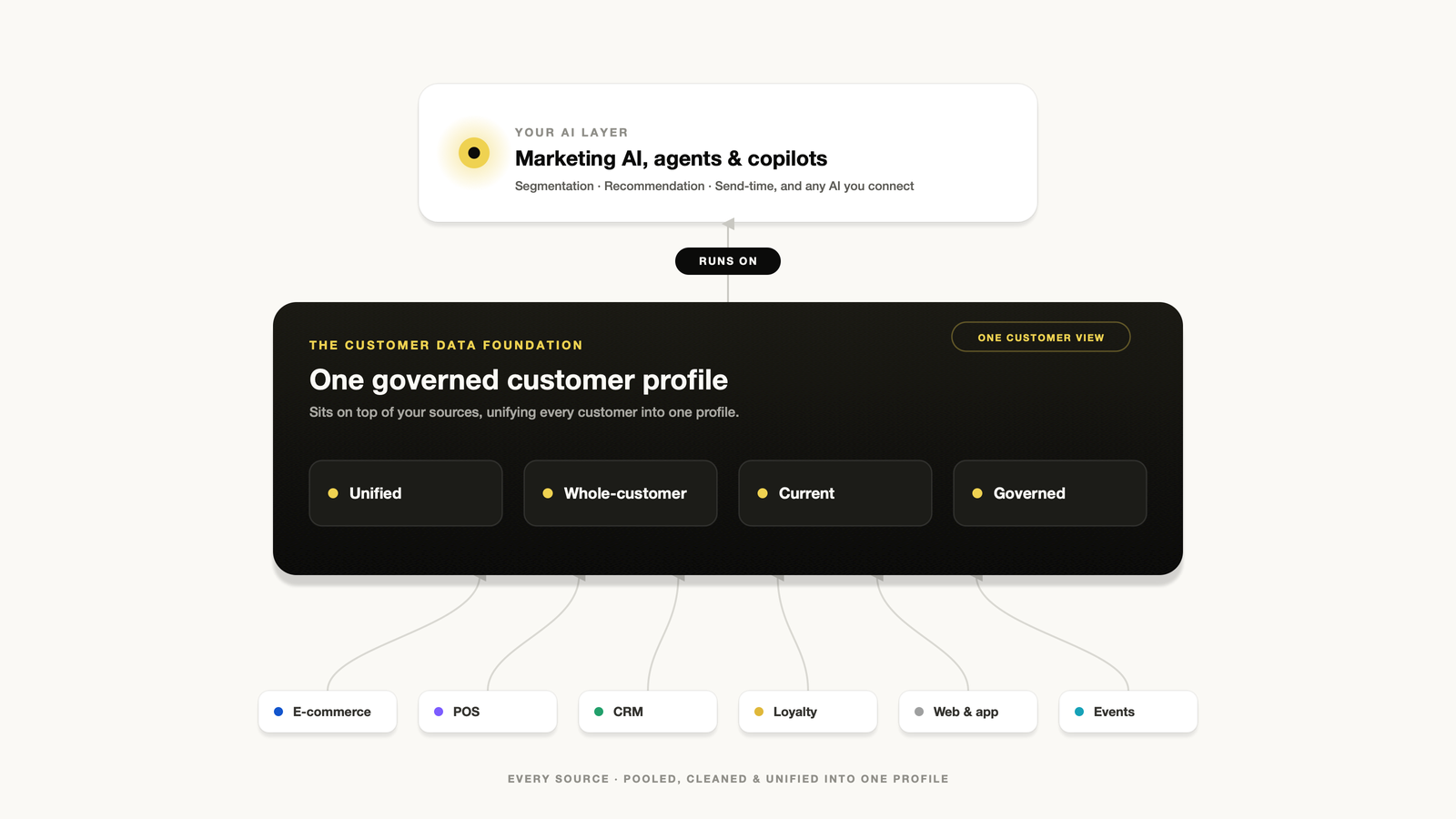
The best predictor of whether AI will improve your marketing is not the model you choose. It is the state of your customer data. Feed AI fragmented, duplicated, half-labelled records and it will make confident, wrong decisions at machine speed. Give it a clean, unified view of each customer and the same models start to earn their keep. That unified foundation is what a customer data platform (CDP) provides, and it is the real reason the same AI works for one brand and quietly fails for another.
It is tempting to think the AI marketing race is about who has the smartest model. In practice, frontier models have become a commodity: any brand can reach the same ones through an API. The gap between brands is not model access. It is what each model gets to read about the customer.
Why the model stopped being the differentiator
A few years ago, access to capable models was a real advantage. That window has closed. The models most marketers would use for segmentation, prediction and content are broadly available, and they improve on a schedule none of us control. Buying a marginally better model is not a strategy anyone can hold onto.
What varies enormously between brands is the data each model is asked to reason over. Consider one customer who shops in your store, browses your website, and carries a card in your loyalty app. If those three touchpoints live in three disconnected systems, an AI recommendation engine sees three strangers, not one person. It personalises badly to all three, and it does so with total confidence.
This is the plain version of "garbage in, garbage out," except AI raises the stakes. A human marketer working from messy data goes slowly and hesitates. A model working from messy data acts instantly, at scale, and rarely flags its own doubt. The brands pulling ahead have not bought better AI. They have done the unglamorous work of unifying their customer data first.
What "good data" actually means for marketing AI
"Good data" is easy to say and vague in practice. For marketing AI, it comes down to four properties. Miss any one of them and the AI on top inherits the gap.
- Unified. One customer, one profile, stitched across store, website, app, loyalty and marketplace. This is identity resolution, sometimes called One ID. Without it, every downstream model works from a fractured picture of the person.
- Whole-customer. Not only what someone bought (orders and on-site behaviour) but who they are (attributes, preferences and consented zero-party data). AI that sees only transactions can optimise the next discount. AI that sees the whole customer can decide whether a discount is even the right move.
- Current. Labelled and refreshed continuously as events stream in, not exported to a spreadsheet once a quarter. A lifecycle stage a model read last month is often already wrong, and a wrong label produces a wrong action.
- Governed. Permissioned, secure and consent-aware by design, so personalisation stays within what the customer actually agreed to. Trust is part of the data quality, not a separate compliance chore.
Notice that none of these are AI features. They are data-foundation features. They are also the part most brands skip, because unifying data is slower and less exciting than switching on a model.
The pattern in brands that get real lift
Look closely at retail brands seeing genuine returns from AI-driven marketing and the same sequence shows up. They fixed the data foundation first, then layered AI on top. Three examples from OmniSegment deployments make the point.
Levi's sold across department-store counters, its own stores and its official site, with data scattered across all three. Denim is a low-frequency purchase, so browsing without buying is common and a traditional CRM could not keep up. The brand connected its online and offline data into one view before doing any advanced personalisation. With that foundation in place, personalised playbooks and membership-tier strategies lifted loyal-customer revenue by 51%, at an average ROAS above 500.
OmniSegment CDP helped us connect our online and offline data and made our marketing smarter. With precise analysis and automation tools, we can quickly get hold of the key data, optimise our marketing strategy, and improve sales efficiency.JEFFREY KUAN · ASSOCIATE DIRECTOR, E-COMMERCE, LEVI'S
A functional-apparel brand had reached the limit of basic RFM segmentation and could not keep online and offline customer data connected. Once member data was unified and segments were rebuilt around real repurchase cycles, overall revenue grew 76% and in-store sales rose 18% year on year. The lever was not a cleverer model. It was a complete customer view the team could finally act on.
Scale does not change the pattern. A major apparel retailer with more than 850 stores and roughly 8 million members integrated three separate data sources into a single customer view in about six months, at a 100% acceptance rate, before AI-driven segmentation ran across that base. The unification was the hard part. The AI was the straightforward part once the data underneath it was right.
How the AI uses a clean foundation
Once the foundation is solid, the AI layer finally has something worth acting on. In OmniSegment, that shows up as three working capabilities that run on the unified profile:
- AI Segmentation finds the right audience automatically, instead of a marketer hand-building lists.
- AI Recommendation personalises what each customer sees next, based on their whole history rather than a single session.
- AI Sending picks the best channel and time for each person, so messages land when they are most likely to be read.
None of this is magic. It is ordinary machine learning made genuinely useful by an unusually complete view of the customer. The emerging agentic layer, AGENTBIT, sits on the very same foundation. It can only reason and act well because the data underneath it is unified and current. AGENTBIT is available now in OmniSegment, and the brands that will get the most from it are the ones that put their data house in order first.
Where to start: four steps before you switch on AI
If the goal is AI that actually performs, the work starts one layer below the AI. A practical order of operations:
- 1. Map your customer data sources. POS, e-commerce, loyalty, ads, service and marketplace. You cannot unify what you have not listed, and most teams underestimate how many silos they hold.
- 2. Resolve identity to one profile per customer. Stitch email, phone, device and loyalty IDs into a single ID so one person is one record, not three. This is the single highest-leverage step.
- 3. Fix labelling and keep it live. Adopt a lifecycle model such as RFM or NASLD that re-labels customers automatically as their behaviour changes, rather than a static export that ages the moment it is saved.
- 4. Only then layer AI on top. With a clean, unified and current foundation, segmentation, recommendation and send-time models have something real to work with. Switch them on in that order, not before.
The brands that skip straight to step four are the ones later wondering why the AI "does not work for us." It usually does work. It is just reading the wrong data.
Key takeaway
- AI marketing performance is decided by data quality, not model sophistication. The same models succeed or fail on the state of the customer data underneath them.
- "Good data" for AI means unified (one profile per customer), whole-customer (attributes as well as transactions), current (continuously re-labelled) and governed (consent-aware by design).
- Brands that see real lift unify their customer data first, then layer AI. Levi's connected its online and offline data before personalisation drove a 51% rise in loyal-customer revenue.
- A customer data platform (CDP) is the foundation that makes AI, and the emerging agentic layer on top of it, actually work.