The short answer
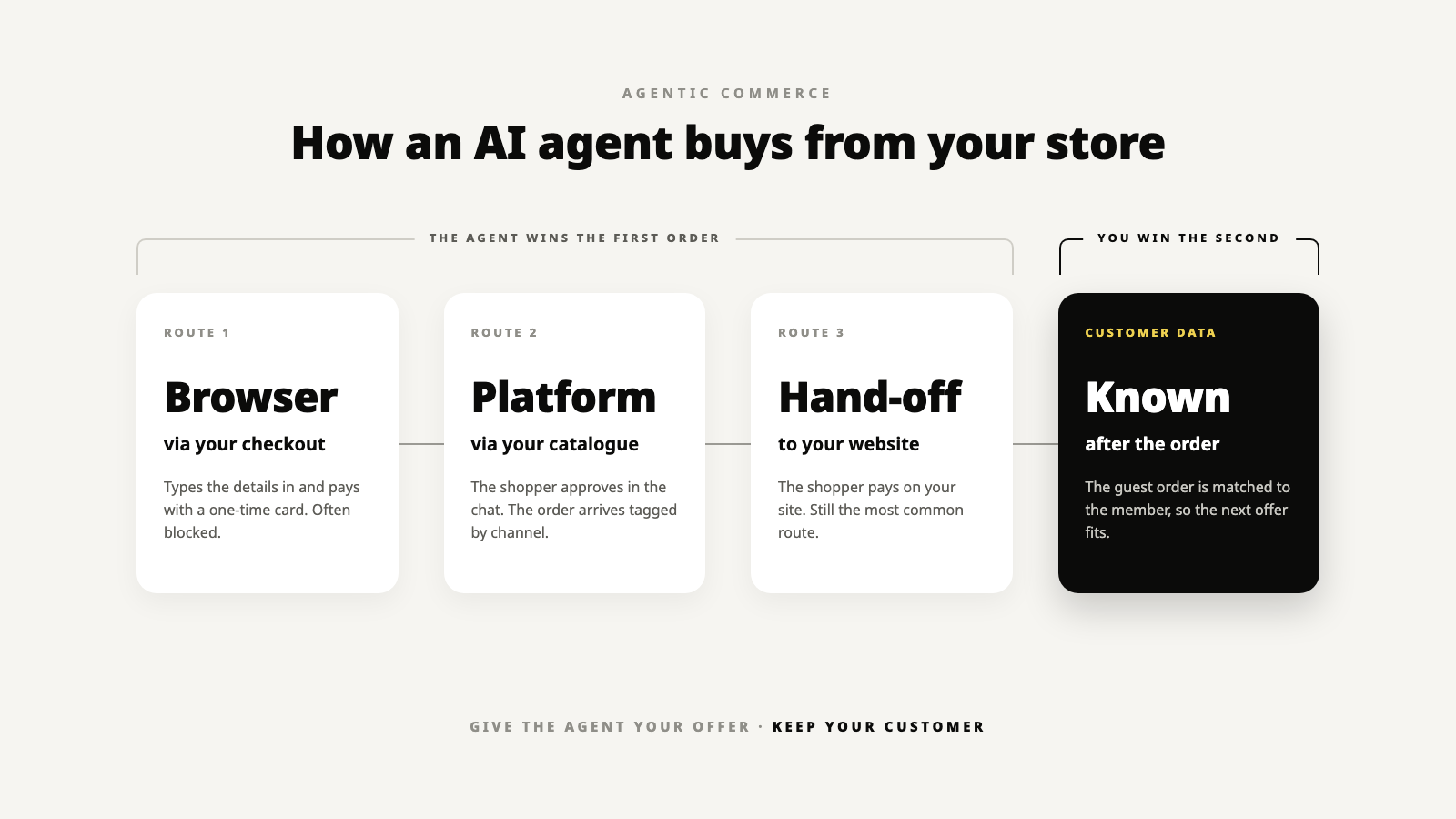
An AI shopping agent buys in one of three ways. It can drive a web browser the way a person would, filling in your checkout form and paying with a one-time card. It can connect to your store through your commerce platform, so the purchase happens inside the chat and the order still lands in your system. Or it can do the research and send the shopper to your website to pay. The second route is growing fastest, partly because the first one keeps getting blocked.
In all three, the brand that fulfils the order still receives it. What the brand often does not receive is the context around it: what the shopper asked, which products they compared, and whether this buyer is already one of its members. That gap decides who owns the customer after the first order.
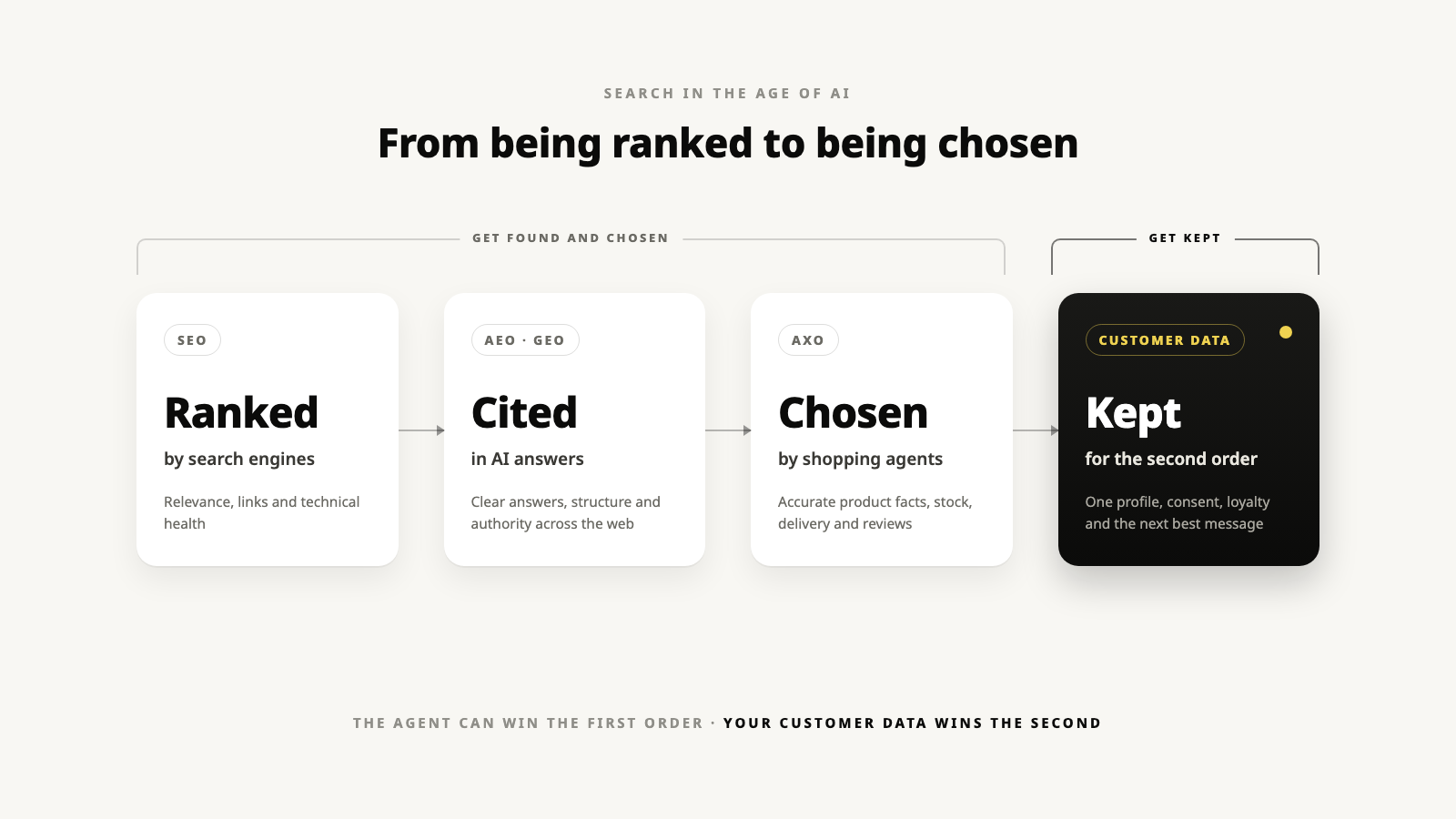
Our guide to GEO, AEO and AXO covers how brands get found and chosen by AI. This article looks at the mechanics underneath: what happens when an agent shops, and what it means for your customer data.
How an AI agent actually shops
Picture a shopper who asks an agent for white tennis shoes for flat feet, delivered by Saturday. The agent searches, compares and shortlists. What happens at checkout depends on the route it takes.
Route 1: The agent drives a browser
The agent opens a real browser, reads product pages, adds the item to the cart and goes to the normal checkout page. It types the shopper's name and address into the form and pays with a one-time virtual card, so the real card number is never shared. Meta's Muse, launched in the US in September 2026, works this way on many sites. It uses a single-use card from Stripe's Link wallet and asks the shopper to approve before it spends.
To the store, this looks like an ordinary guest checkout. The store may never know an agent placed it.
Route 2: The agent connects through the commerce platform
Here no web page is involved. The store's catalogue and checkout are available to the agent as data. Shopify and Meta announced this for Muse in September 2026: the agent searches Shopify Catalog, shows the shopper the total, takes approval in the chat and pays with Shop Pay. The order arrives in the merchant's Shopify admin, tagged to Meta as a sales channel. For eligible US stores the channel is switched on by default, and merchants can turn it off.
Open standards are being built for the same job, including the Agentic Commerce Protocol from OpenAI and Stripe and the Universal Commerce Protocol from Google and Shopify. Both keep the brand as the merchant of record.
Route 3: The agent hands off
The agent researches, recommends and sometimes builds the cart, then sends the shopper to the brand's website or app to pay. The brand gets the full visit. For now this is still the most common route.
| Route | How it pays | What the brand sees | Main risk |
|---|---|---|---|
| Drives a browser | A one-time card typed into the normal checkout | A guest order, often with no sign an agent placed it | Blocked by bot protection |
| Connects through the platform | A wallet inside the chat, such as Shop Pay or Link | The order, name, email, phone and address, tagged by channel | The brand is one listing among many |
| Hands off | The shopper pays on the brand's site | The full visit and the order | The shopper arrives late in the decision, with little patience for friction |
Why websites block shopping agents
Every step between a visitor and a paid order was built to stop automation: bot protection at the network edge, login and loyalty screens, fraud scoring and payment checks. That is the right design against scrapers and fraud. It also treats a legitimate agent buying for a real customer as a threat. Some retailers block agents on purpose. Amazon blocked Muse, according to Bloomberg.
So the funnel needs reading differently. Agents rarely abandon carts the way people do. What matters is how many legitimate agents get through your checkout at all. Card networks are working on ways for an agent to prove it acts for a real, consenting shopper, such as Visa's Trusted Agent Protocol and Mastercard Agent Pay. Merchants want an answer to a simpler question: who is the person behind this agent?
For now, the practical step is to check what your bot protection and checkout do to AI agents, and to decide which ones to allow instead of leaving it to default settings.
Is Shopify becoming a marketplace?
For discovery, partly. When Muse searches Shopify Catalog for tennis shoes, your products sit in one list next to every other Shopify store, ranked by an agent you do not control. At that moment it behaves like a marketplace. The transaction works differently.
| Marketplace | Agent through your commerce platform | Your own website | |
|---|---|---|---|
| Where the shopper searches | The marketplace | The agent, using a shared catalogue | Your site |
| Who sells | You, on the marketplace's terms | You, as merchant of record | You |
| Fees | Marketplace commission and fees | At launch, Shopify listed no fee beyond normal payment processing for Meta checkout | None |
| Customer contact details | Limited | Name, email, phone and address | Everything you collect |
| What the shopper asked | Stays with the marketplace | Stays with the agent | Yours |
The platform gains something the brand does not. A wallet such as Shop Pay knows the shopper across many stores, while each brand sees only its own orders.
Compared with the marketplace trade-off, the difference is that the agent does pass the customer's details to you, once, as a guest order. Whether that buyer becomes your customer depends on what you do next.
Three things agents change about selling
Agents do not build baskets
A person buying tennis shoes might add socks and a cleaning kit. An agent usually buys exactly what it was asked for. Cross-selling moves to after the purchase, as a follow-up that suggests the right add-on to the right customer at the right time.
Offers an agent cannot read do not count
Agents compare what they can see: price, delivery, stock and reviews. A member benefit hidden behind a login plays no part in the decision. A public discount code has the opposite problem. Any agent can find it and apply it, so a blanket code risks becoming a price cut for everyone. Offers tied to the member hold up better, such as points, member pricing or a perk that applies once the customer is recognised.
Product facts decide, and mistakes come back as returns
An agent reads every field on a product page. If an attribute is missing, the agent moves on to another brand. If it is wrong, the agent may buy the wrong item, and that order comes back as a return. Complete, accurate product data is now part of conversion.
When an agent buys for your best customer
Say a long-standing VIP member asks her agent to reorder her usual moisturiser. How does your brand know it is her?
Who sends what
The agent brings an identity signal to the store: the email and phone number on the order, a loyalty account the shopper has linked inside the agent (newer commerce standards support this), or a normal login with the shopper's saved password. The store recognises the member and replies with a decision, such as a member price, points, free delivery or a relevant add-on.
The profile itself stays with the brand. Give the agent your offer, not your customer. Passing a customer's full history to a third-party agent raises data-protection questions under laws such as the PDPA in Malaysia and Singapore, and it hands your most valuable asset to the intermediary. Your own agents are a different case. An AI assistant on your website or WhatsApp works for you, so it should see the full customer context.
How a guest order is matched to a member
Most agent orders arrive as guest checkouts. Matching one to an existing member usually happens in two steps.
- The commerce platform links it first. On Shopify, a guest order placed with an email that belongs to an existing customer is normally attached to that customer's record.
- The customer data platform joins it to the whole profile. In OmniSegment, orders synced from the store are matched to existing profiles by the store's customer ID, and orders from other sources can be matched by phone number. Phone numbers are stored in a standard international format, which helps when the same number is written differently across systems. The order then sits alongside the member's in-store purchases, loyalty status and consent.
The match breaks when:
- the agent account uses a different email from the membership
- an agent wallet passes a masked or relay email address
- the order carries no phone number
- a household shares one phone number, which can merge two people into one
The fix is basic data work. Collect a verified phone number and email from members at every touchpoint, in store and online, before agents arrive in volume. Every member you can identify by both is a member you can recognise when an agent buys for them. A well-designed membership programme makes this much easier.
Once the order is matched, the rest is familiar retention work: a welcome journey that asks first-time buyers for membership and consent, a reorder reminder timed to each customer's buying cycle, personalised recommendations for the add-on the agent skipped, and a way to compare AI-sourced customers with your other channels.
What this means in Southeast Asia
Agent checkout on brand stores is starting in the US. Meta's direct checkout through Shopify is limited to shoppers in the US, Canada and Mexico. In Southeast Asia, platform agents arrived first: Shopee's app has been available inside ChatGPT in six markets since June 2026, so a conversation can end with a sale on Shopee.
According to beBit TECH's industry research, agent-completed purchases will remain a small share of retail in Malaysia, Singapore and Indonesia for the next few years. The change already under way is discovery, with shoppers asking AI what to buy before they visit a store or a website. That gives brands time, and the preparation pays off today anyway.
What to do now
- Check what your bot protection does to AI agents, and choose which agents to allow.
- Complete your product attributes and keep price, stock and delivery accurate everywhere they appear.
- Review your commerce platform's AI channel settings, so you know where your catalogue shows up.
- Record the source of every order, including AI channels, so agent-sourced customers become a segment you can act on.
- Collect a verified phone number and email from members, online and in store.
- Shift from public discount codes to offers tied to the member.
- Build a post-purchase journey for first-time buyers that asks for membership and consent, suggests the right add-on and requests a review.
The last four are customer data work. OmniSegment brings online orders, in-store purchases and loyalty data into one profile per customer, and runs the follow-up journeys across email and WhatsApp. See how it works for omnichannel retail brands.
Frequently asked questions
How does an AI agent check out on a website?
In two main ways. It can use the website's own checkout page like a person, typing in the shopper's details and paying with a one-time card. Or it can connect through the store's commerce platform, so the purchase is completed inside the chat and the order arrives in the merchant's system. In both cases the brand normally remains the seller and fulfils the order.
Can websites block AI shopping agents?
Yes. Bot protection, login screens and fraud checks often stop automated shoppers by default, and some retailers block agents on purpose. Brands should decide which agents they want to allow rather than leave it to default settings.
Does Meta's Muse work with Shopify stores?
Yes, in the US. Shopify and Meta announced in September 2026 that Muse can search Shopify Catalog and check out with Shop Pay. Orders arrive in Shopify tagged to Meta. The channel is on by default for eligible stores and can be switched off.
What customer data does a brand get from an agent purchase?
Usually the order, plus the buyer's name, email, phone number and delivery address. Usually not what the shopper asked the agent, which products were compared, or any browsing behaviour. Marketing consent and member recognition are not guaranteed.
How can a brand recognise a loyalty member who buys through an agent?
By matching the order's email or phone number to an existing member profile, by supporting linked loyalty accounts as commerce platforms add them, and by collecting verified contact details from members in advance.
Is agentic commerce available in Southeast Asia?
Partly. AI-assisted discovery is already common, and Shopee's app is available inside ChatGPT in six Southeast Asian markets. Agent checkout on a brand's own store, such as Muse with Shopify, is starting in the US.
Key takeaway
- Agents shop in three ways: driving a browser, connecting through the commerce platform, or handing the shopper to your site. The platform route is growing because browsers get blocked.
- The brand still gets the order. It can lose the conversation, the browsing data and the knowledge that the buyer is a member.
- For discovery, a shared platform catalogue works like a marketplace. For the transaction, the brand is still the seller.
- Agents buy exactly what they are asked for, compare only what they can read, and turn wrong product data into returns.
- Share offers with agents and keep customer profiles in house. The agent can win the first order, and your customer data wins the second.