The short answer
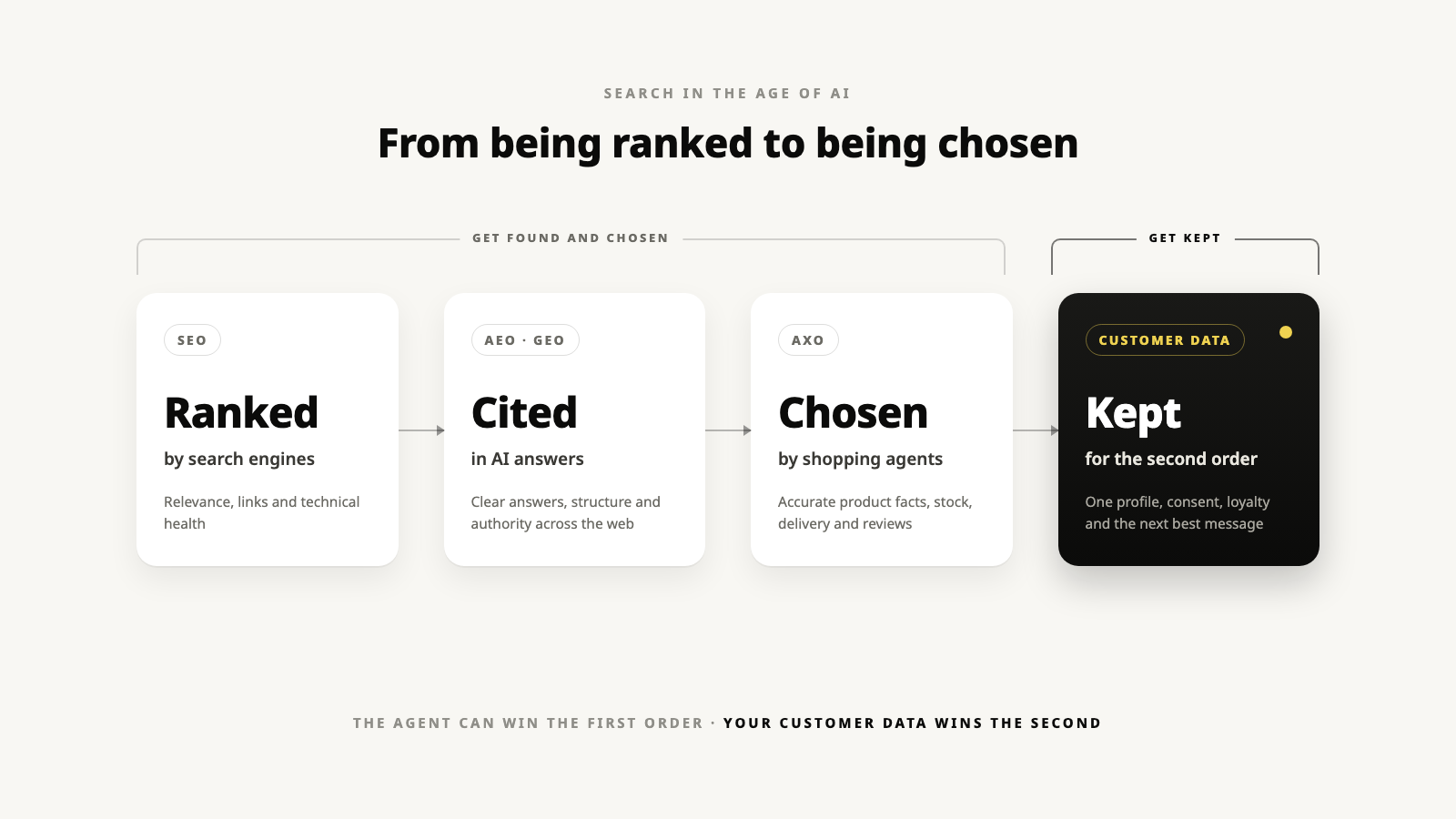
Search engine optimisation (SEO) was about getting ranked. AI adds three new goals on top of it. AEO (answer engine optimisation) and GEO (generative engine optimisation) are about being the answer an AI gives, and being cited or recommended when a shopper asks ChatGPT, Gemini or Perplexity for advice. AXO (agent experience optimisation) goes one step further. It is about being chosen by an AI agent that shops on the customer's behalf, comparing price, stock, delivery and fit before it recommends a product or buys it.
Most of the work to get found and chosen sits in your product data, your content and your reputation across the web. That covers half the job. An agent that brings you a customer does not pass on the relationship, so whether that customer orders again depends on what you know about them. That part is a customer data question.
From search, to answers, to agents
For two decades the path to purchase started in a search box. Three changes are now happening at the same time.
- Search is becoming answers. Instead of ten blue links, the shopper gets one written answer that names a handful of brands. If you are not in that answer, you are not on the shortlist.
- Answers are becoming actions. AI assistants are starting to carry out tasks for the shopper. Meta launched Muse, a personal AI agent that can shop and check out on a user's behalf, in the US in September 2026. Shopify shares its merchants' product catalogues with Muse by default.
- Platforms are building their own agents. Since June 2026, Shopee's app has been available inside ChatGPT for shoppers in Indonesia, Malaysia, the Philippines, Singapore, Thailand and Vietnam. A conversation in ChatGPT can now end with a product sold on Shopee.
AI-referred traffic is still a small share of visits, but it performs well. Adobe Analytics reported that AI traffic to US retail sites grew 393% year on year in Q1 2026, and that in March 2026 it converted 42% better than other traffic. These shoppers have already asked their questions by the time they arrive, so they tend to know what they want.
SEO, AEO, GEO and AXO explained
The acronyms overlap, and people often use them interchangeably. The clearest way to tell them apart is by what each one wins you.
| Optimises for | The win | What decides it | |
|---|---|---|---|
| SEO | Search engines such as Google and Bing | A high ranking on the results page | Relevance, links, technical health |
| AEO | Answer surfaces: AI Overviews, featured snippets, voice assistants | Being the direct answer | Clear, well-structured answers to real questions |
| GEO | Generative AI assistants such as ChatGPT, Gemini and Perplexity | Being cited or recommended | Authority, consistency and mentions across the web |
| AXO | AI agents acting for a shopper | Being chosen, and bought | Accurate, machine-readable facts: price, stock, delivery, fit, policies, reviews |
SEO still matters. AI assistants draw heavily on the open web and on search indexes, so good SEO remains the base for everything above it. What changes is who is reading. A person skims a product page and fills in the gaps. An agent reads every field, and if the fact it needs is missing or contradicts another source, it moves on to the next brand.
Where AI commerce and agentic commerce are heading
It helps to separate three modes of AI shopping, because they are moving at very different speeds.
- 1. AI-assisted discovery (happening now). The AI recommends, and the shopper clicks through and buys on the brand's own site or app. The brand keeps the full relationship. This is where the growth is today.
- 2. Agent checkout (tried, now being rebuilt). The agent completes the purchase inside the conversation, using open standards such as the Agentic Commerce Protocol from OpenAI and Stripe, or the Universal Commerce Protocol from Google and Shopify. Both keep the brand as the merchant of record, so the order is still yours. The first attempts were scaled back: OpenAI revamped ChatGPT's shopping experience in March 2026 after its Instant Checkout launch. Expect agent checkout to return in stronger forms, one market at a time.
- 3. Delegated buying (early). "Reorder my usual" without approving each purchase. Shoppers are not ready yet. In a September 2026 ACI Worldwide survey of more than 3,300 US and UK consumers, only 7% said they would let AI make purchases without their approval.
It also matters whose side each agent is on. Shoppers' agents, such as ChatGPT, Gemini and Muse, work for the customer and compare brands on their merits. Platform agents, such as Shopee inside ChatGPT, work for the marketplace, and the sale completes there. Brand agents, such as an AI assistant on your own website or messaging channels, work for you.
In Southeast Asia, platform agents arrived first. For brands, this is the familiar marketplace trade-off in a new form: the marketplace keeps the customer and the brand gets the order. According to beBit TECH's industry research, the change in discovery is the live issue for Southeast Asian brands today, and agent checkout will follow over the next few years as these services expand beyond the US. The product data and reviews a brand builds now will already be in place when it does.
What is in it for brands
For brands, the opportunity starts with intent. AI-referred shoppers arrive further along in their decision, which is why they convert better. Product facts also carry more weight. An agent compares products on their details and on what other customers say, so a brand with complete, accurate information and strong reviews can earn a recommendation that ad spend alone would not buy.
Shoppers also ask agents things they would never type into a search box, such as "a teal lounge set under $100 with a relaxed fit that arrives by Friday". A brand that can answer a specific question like that wins a specific customer.
There is a catch that most AXO advice skips. When an agent completes a purchase, the brand still receives the order, the customer's name, email and delivery address. What it can lose is everything around that order:
- The demand signal. What the shopper asked for, and which alternatives they compared, usually stays with the agent.
- Browsing behaviour. On-site tracking does not fire if the shopper never visits your site.
- Marketing consent. Opt-in is not guaranteed to be captured in an agent checkout.
- Member recognition. Agent purchases often arrive as guest orders, so a loyal member can look like a stranger.
The agent can win you the first order. The second order has to come from your own relationship with the customer.
How to get found and chosen by AI: five layers
Think of AI readiness as five layers. The first three are mostly website, catalogue and content work. The last two depend on your reputation and your commerce setup.
1. Be reachable
- Check that the AI crawlers you want, from OpenAI, Google, Perplexity, Anthropic and others, are not blocked in your robots.txt file or by your bot-protection settings. Some security and CDN services now block AI crawlers by default.
- Make sure your main content is in the page's HTML and not only loaded by JavaScript. Many AI crawlers do not run scripts.
2. Be structured
- Add schema.org markup for products, offers, ratings, reviews, shipping and return policies, and store locations with opening hours.
- Keep product feeds complete and in sync: price, availability, variants, size, colour and material. If you sell on Shopify, review the settings that control which AI channels can see your catalogue.
- Keep every fact consistent everywhere it appears. An agent that finds two different prices or delivery promises has no reason to trust either.
3. Be answerable
- Write product content for the questions shoppers ask: what it is for, who it suits, how it fits, what it is made of, how to care for it and how it compares.
- Use your customers' own words. On-site search terms, return reasons and service questions show exactly how people describe what they need.
- Publish clear, direct answers on policies: delivery times by area, returns, warranties and, where relevant, halal certification.
4. Be cited elsewhere
- AI assistants weigh what others say about you, not only what you say about yourself. Reviews, ratings, marketplace listings, media coverage, comparison articles and community discussions all count.
- Review volume and recency matter. A steady flow of genuine reviews from real customers is one of the strongest signals a brand can build.
5. Be transactable
- Keep stock, pricing and delivery promises accurate in real time. A recommendation that fails at checkout is a lost sale.
- Keep checkout simple, fast and friendly to guest buyers, and adopt your commerce platform's agent checkout options as they reach your market.
Two mistakes are common. One is treating this as a website-only project, when reviews, feeds and marketplace listings carry as much weight. The other is chasing shortcuts: there is little evidence so far that major AI engines read llms.txt files, for example. Product data, content and reviews deserve the effort first.
How to win the second order
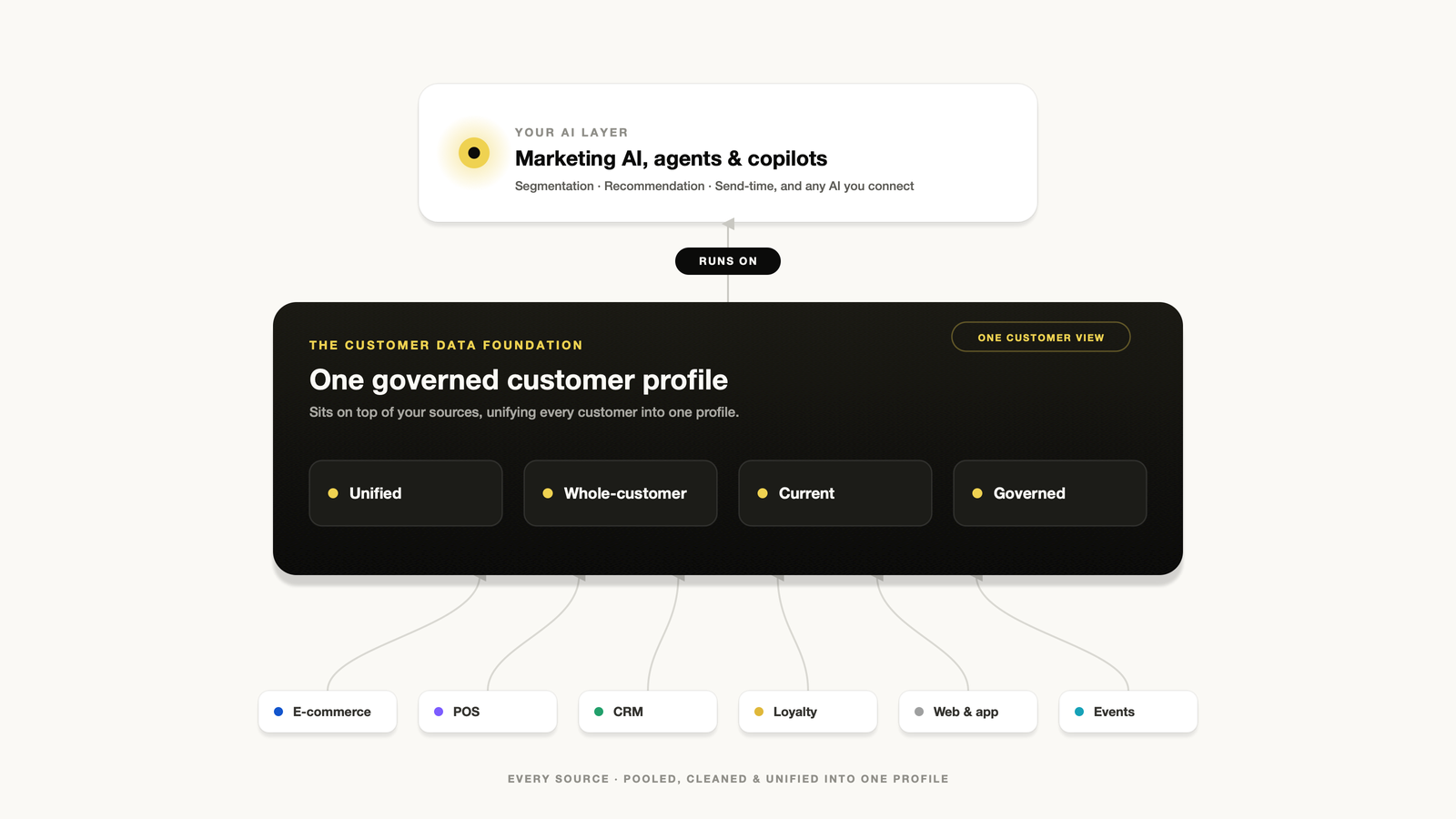
Getting found and chosen is the acquisition half of AXO. The retention half is where a customer data platform (CDP) earns its place, because every gap the agent leaves behind is a customer data problem.
- Recognise AI-sourced customers. Tag AI-referred visits with UTM data and record where each order came from, so customers who arrived through AI become a segment you can see and act on.
- Match guest orders to real customers. Link each guest order to an existing profile by email or phone, so a returning member is recognised instead of being counted as a new buyer. In OmniSegment, One ID joins these identities into one profile across online, in-store and loyalty data.
- Earn consent and membership. Follow the first order with a welcome journey that invites the customer to join your loyalty programme and opt in to email or WhatsApp. This is the moment an agent-acquired buyer becomes your customer.
- Ask for the review. A post-delivery review request turns happy customers into the ratings AI assistants read. Your retention work then feeds your discovery.
- Make the next order personal. With orders and profiles unified, AI Recommendation and AI Sending can pick the next product, channel and send time for each customer, across email, WhatsApp and SMS.
- Measure the channel. Compare AI-referred customers with other channels on repeat purchase and lifetime value, so you know what an AI-sourced customer is really worth.
- Prepare for member linking. New commerce standards let shoppers link a loyalty account inside an agent to get member prices and points. When that reaches your market, brands with a clean, unified member record will be the ones agents can recognise.
A 90-day plan
- Days 1 to 30: audit. Ask ChatGPT, Gemini and Perplexity the questions your customers ask, and note which brands they name. Check your robots.txt and bot protection, your structured data and how complete your product feeds are. Set up UTM and order-source tracking so AI-referred customers are visible from the start.
- Days 31 to 60: fix the foundation. Fill in missing product attributes, add schema markup, rewrite your top product pages around real customer questions and spell out your policies. Start a post-delivery review journey.
- Days 61 to 90: build the second-order loop. Unify online, in-store and loyalty data into one profile per customer. Launch a welcome journey for first-time and AI-referred buyers that asks for membership and consent. Start comparing AI-referred customers with your other channels.
Frequently asked questions
What is the difference between AEO and GEO?
AEO focuses on being the direct answer on answer surfaces such as AI Overviews, featured snippets and voice assistants. GEO focuses on being cited or recommended inside responses from generative AI assistants such as ChatGPT, Gemini and Perplexity. In practice the work overlaps: clear answers, structured data and authority across the web.
What is AXO?
AXO, or agent experience optimisation, is the practice of making a brand easy for AI agents to understand, trust and buy from when they act on a shopper's behalf. It covers machine-readable product facts, accurate stock and delivery data, clear policies, reviews and checkout that agents can complete.
Is SEO still important in the age of AI?
Yes. AI assistants draw heavily on the open web and on search indexes, so strong SEO remains the foundation. GEO and AXO build on it rather than replace it.
Is agentic commerce available in Southeast Asia?
Partly. AI-assisted discovery is already here, and Shopee's app is available inside ChatGPT in six Southeast Asian markets. Agents that check out on a brand's own store, such as Meta's Muse, launched first in the US. Expect discovery to change first and agent checkout to follow.
How does a CDP help with AXO?
A CDP does not make a brand visible to AI on its own. That is mainly product data, content and reputation work. A CDP handles what happens next: recognising AI-sourced customers, matching guest orders to existing members, earning consent and loyalty sign-ups, generating reviews and measuring the AI channel.
Key takeaway
- SEO gets you ranked, AEO and GEO get you cited in AI answers, and AXO gets you chosen by agents that shop for customers.
- AI-referred shoppers are still a small share of traffic, but in the US they now convert better than other visitors.
- Agentic commerce is arriving in stages: discovery now, agent checkout next, delegated buying later. In Southeast Asia, platform agents such as Shopee in ChatGPT came first.
- Getting chosen is mostly product data, content and reviews, built in five layers: reachable, structured, answerable, cited and transactable.
- The agent can win you the first order. Unified customer data, consent and loyalty win you the second.