What is AGENTBIT?
AGENTBIT is the agentic layer of OmniSegment, beBit TECH's customer data platform. You describe what you want in plain words, such as "members who bought Vitamin C but haven't come back," and its agents build the segment, find the likely buyers or draft the full journey from your unified customer data. Every draft waits for your approval before anything goes live. AGENTBIT is available now to every OmniSegment client, inside the same account.
One campaign, four handoffs
Ask any CRM or retention marketer for their campaign backlog and you will get a long list. A replenishment reminder for products with a predictable cycle. A win-back for VIPs who have gone quiet. A launch message for the customers most likely to want the new range. A payday push, an 11.11 plan, a thank-you for members who now shop both online and in store.
Most of that list never runs. The idea is rarely the problem. The problem is everything between the idea and the send, and how much of it is spent waiting on someone else.
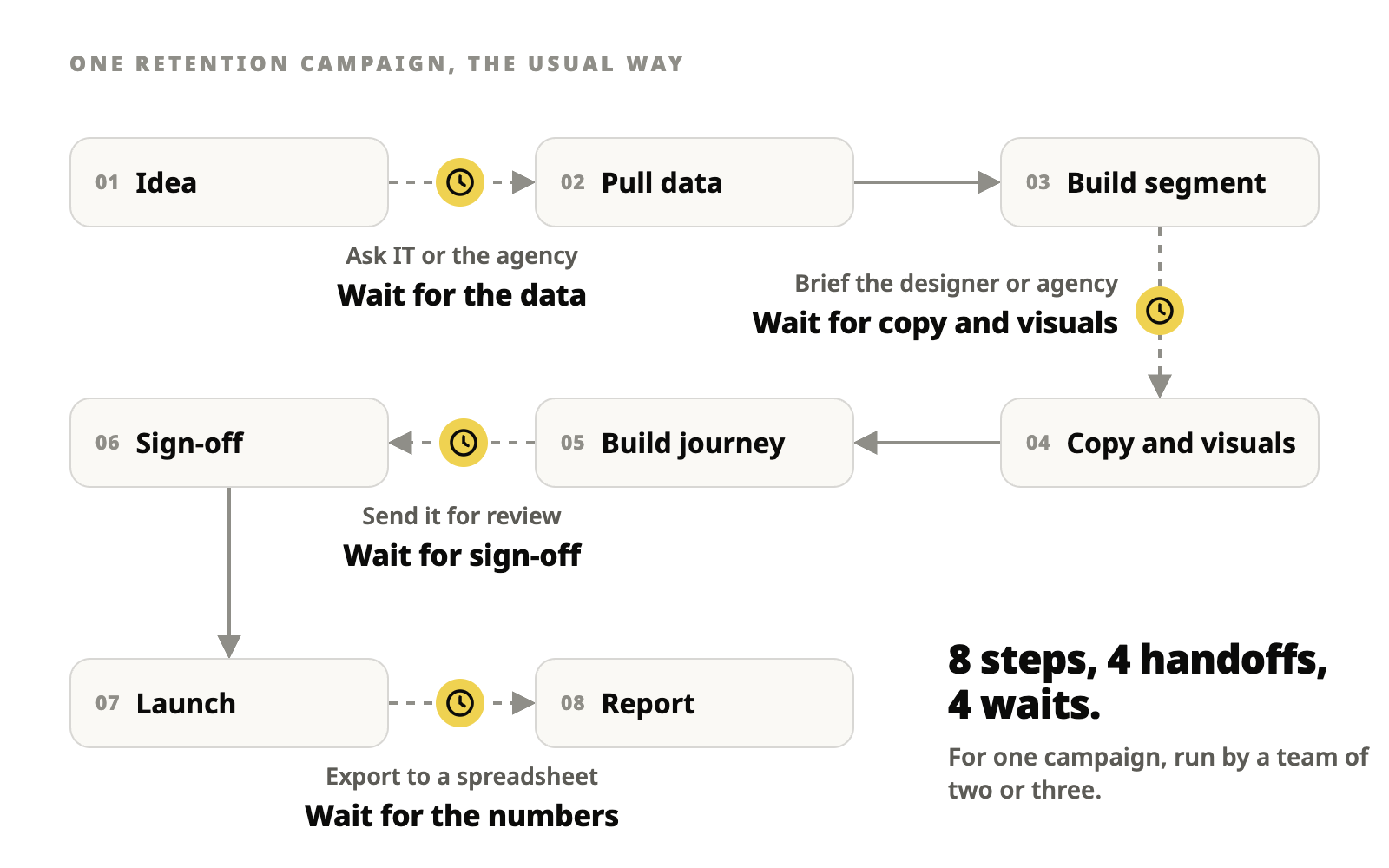
Here is how one campaign usually moves through a mid-market brand:
- Pull data. The marketer asks IT, the agency or whoever can reach the POS and e-commerce data for a customer list, waits for it, then cleans the export in a spreadsheet.
- Build segment. The list is rebuilt as filters in the marketing platform and checked against the numbers.
- Copy and visuals. A brief goes to the designer or agency, followed by a wait and a round of changes.
- Build journey. Someone assembles it node by node: trigger, filter, channel, wait, tag. Then it gets tested.
- Sign-off. A manager reviews it when they have time.
- Launch and report. It goes live, and the results come back as an export that someone turns into a spreadsheet.
Each step makes sense on its own. Together they turn one idea into a small project with four handoffs, and much of the elapsed time goes to waiting for the next person. Timely ideas suffer most: by the time a payday or 11.11 campaign is ready, the moment has often passed.
In large companies each step has an owner and a queue. In most mid-market brands in Southeast Asia, the same two or three people carry the whole chain, on top of paid media, marketplaces and store events. So the team runs the campaigns it already has, and the backlog stays a backlog.
A customer data platform removes some of these waits. With every customer in one profile, the data step gets shorter, and journeys run on their own once they are built. The workflow itself stays the same: a person still has to translate a business goal into filters, nodes and settings, one click at a time.
What AGENTBIT changes
AGENTBIT takes the build steps out of the queue. Pulling the data, building the segment and assembling the journey happen in one conversation, inside OmniSegment, on customer data that is already unified. It works in three steps:
- You ask. State the goal or the audience the way you would brief a colleague.
- The agents build. They read your OmniSegment customer data, do the work and show their reasoning.
- You approve. You review the draft, adjust it if needed, and activate it.
You don't need a rule builder, SQL or a data request to get there. What comes back is a real segment, a ranked audience or a configured journey inside OmniSegment, ready to use.
Meet the agents
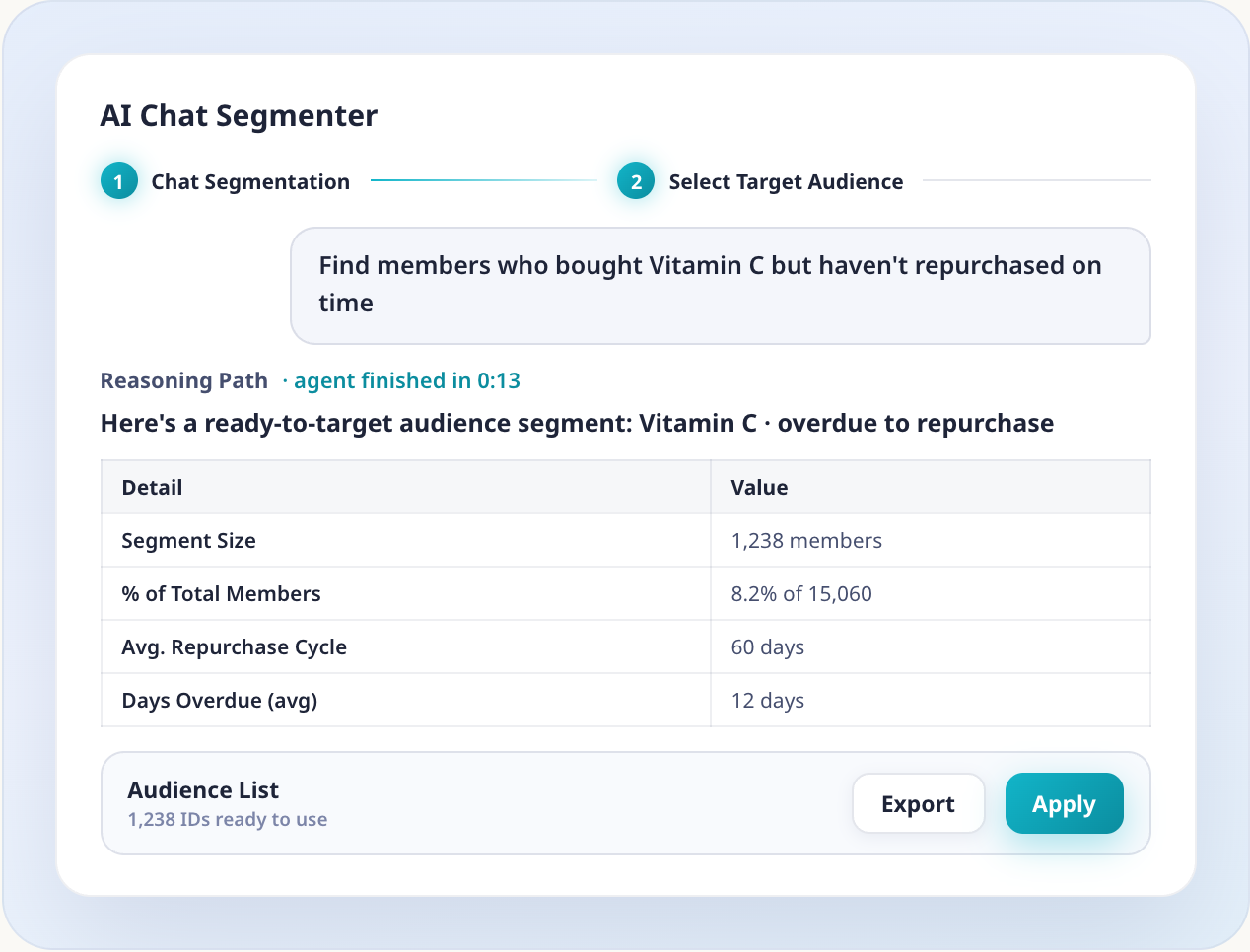
AI Chat Segmenter: build any audience by asking
Describe who you want: "members who bought Vitamin C but haven't come back." The agent reads your unified customer profiles and returns the exact segment, sized and profiled, with a reasoning path that shows why each customer is in it. You can apply it to any journey or export the list.
AI Product Interest Finder: find the people most likely to buy
Pick any product in your catalogue, for example a new fish oil line. The agent studies who browses and buys it, looking at category habits, repurchase cycles and spending power. It returns a ranked audience of the members most likely to buy, which drops straight into a journey as a data source.
AI Strategy Helper: from a goal to a working journey
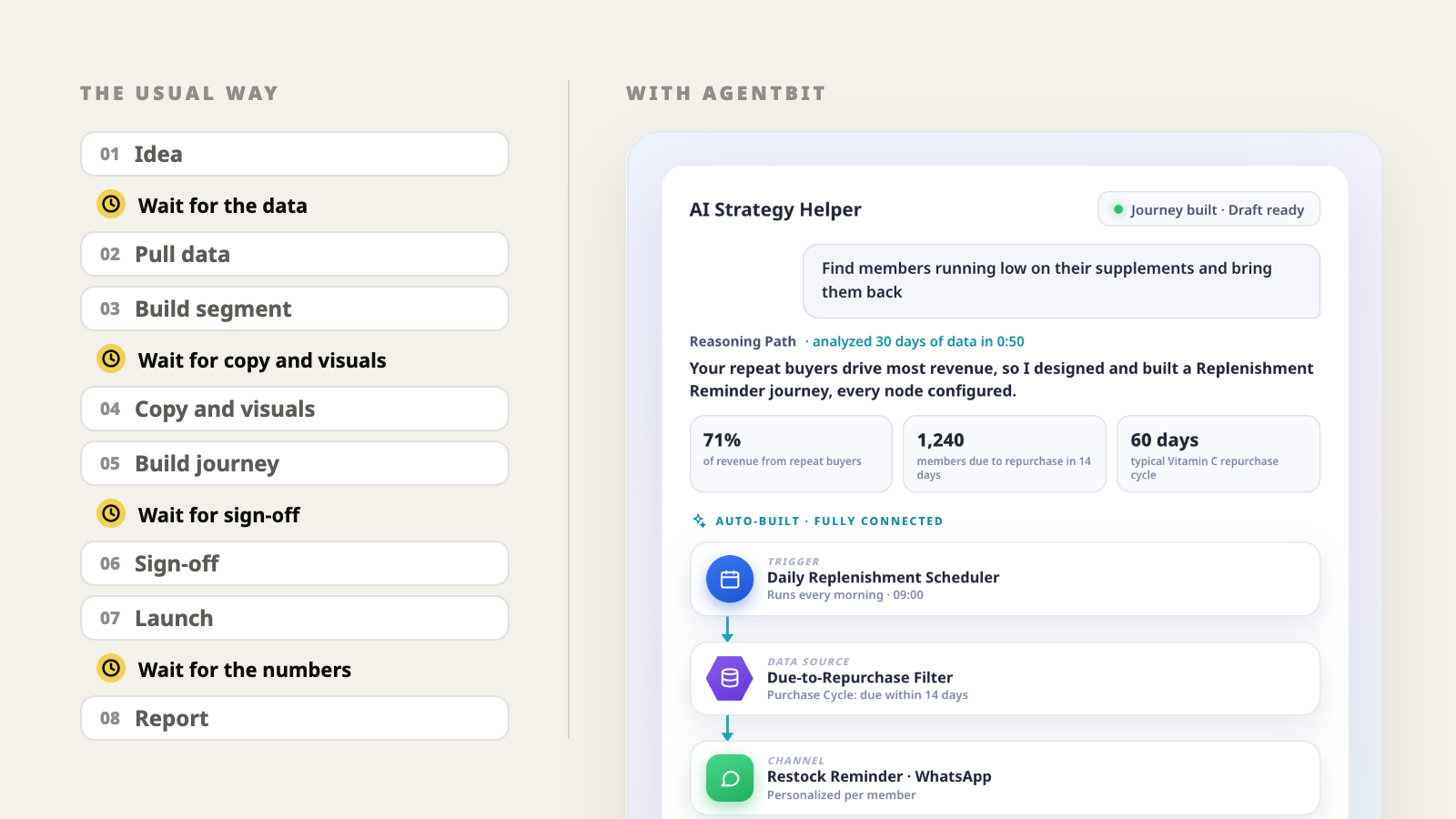
Give it the outcome you want, such as "plan a payday win-back for VIPs who have gone quiet." The agent analyses your recent campaigns and data, proposes a strategy, then builds the journey with the segment, channel, waits and tags configured and every connection checked. It arrives as a draft, never live.
Take a pharmacy brand. The Strategy Helper finds that repeat buyers drive most of its revenue and that a group of members is due to repurchase within 14 days. It builds a replenishment journey: a daily scheduler, a due-to-repurchase filter, a personalised WhatsApp reminder, a three-day wait and a tag on every member reminded. The marketer reviews it and activates it. Their job moves from building the journey to judging it.
Why the agents need a brain underneath
What an agent can build depends on what it knows about the customer. An agent working from an email list sees opens and clicks. It does not know that a customer buys in store every two months, redeemed points last week and browsed the new range last night.
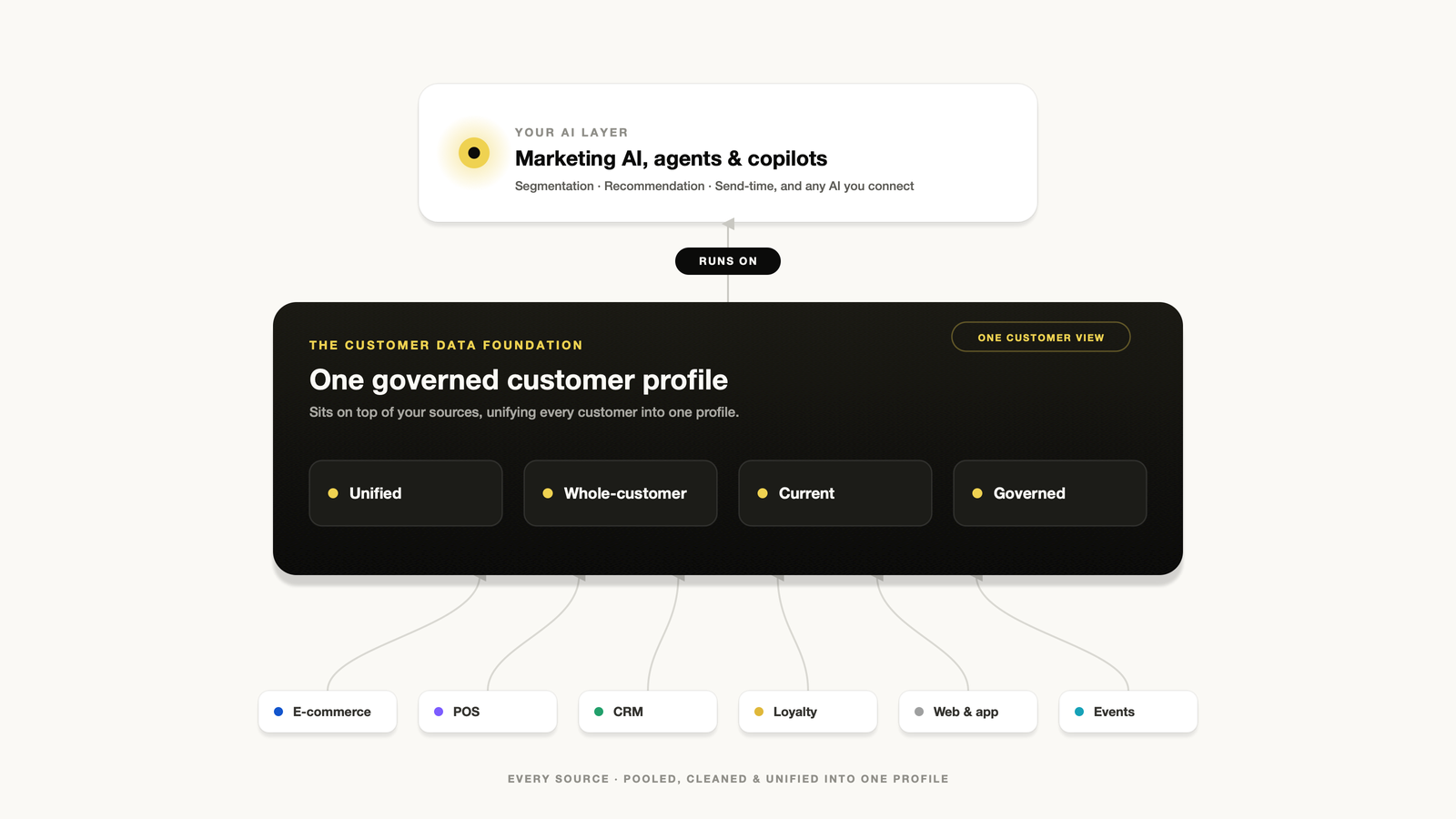
AGENTBIT works on OmniSegment's data context layer: one profile per customer under One ID, built from O-Data (who they are, what they bought) and X-Data (what they do, captured live), with purchase history, intents and signals from every connected source. This is why its segments hold up and its journeys make commercial sense. It reads the same customer your marketer would, across the whole base at once.
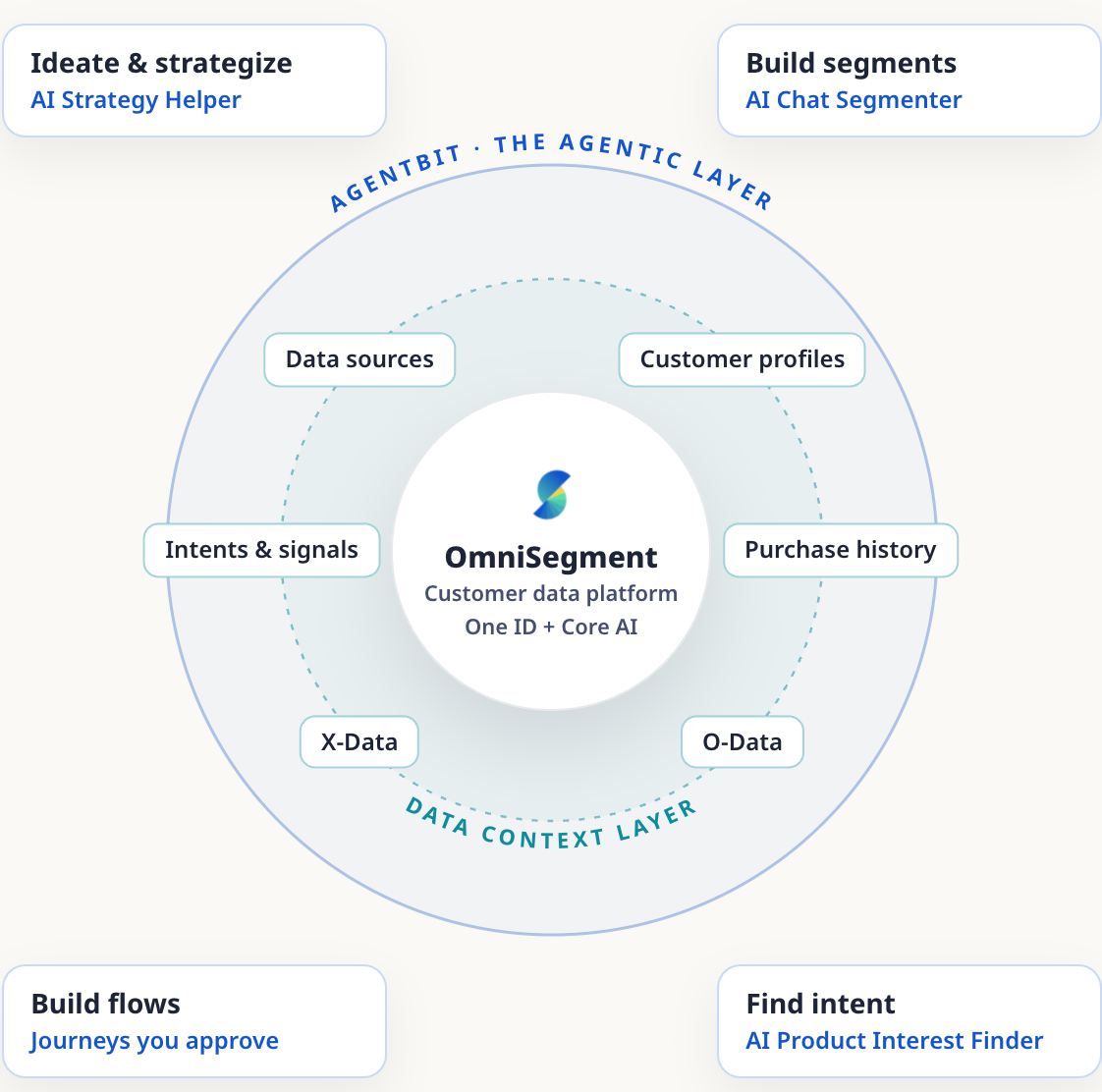
It also means there is nothing new to integrate. AGENTBIT runs inside the OmniSegment account the brand already uses, on the data already there. The agents build better work as the data underneath gets richer, which is why the customer data foundation comes first.
You stay in control
Agents that act on customer data need clear limits, and AGENTBIT is built around them. Segments, audiences and journeys come back as drafts, and nothing reaches a customer until someone on your team activates it. Each result shows its reasoning path, so you can see the data the agent read, what it found and why it built what it built.
The agents also build with the same segments, channels and journey nodes your team already uses. Anything they make can be inspected and changed like any other journey. Your team keeps the strategy and the final call, and spends far less time on the build.
The campaigns you can finally run
With the build handled, the backlog becomes a plan:
- Replenishment for any product with a repurchase cycle, timed to each member.
- VIP win-back for high-value members who have gone quiet, before they lapse for good.
- Product launches aimed at the members most likely to buy, instead of the whole list.
- Seasonal moments such as payday, 11.11, Raya or Chinese New Year, planned from what each segment bought last time.
- Online-to-store journeys for members who shop in both places, from one profile.
Frequently asked questions
Do I need a separate system for AGENTBIT?
No. AGENTBIT is the agentic layer inside OmniSegment and is available now to every OmniSegment client, in the same account.
Does AGENTBIT send messages on its own?
No. The agents build drafts. A person on your team reviews and activates every segment and journey.
What data does AGENTBIT use?
The unified customer data already in your OmniSegment account: profiles, purchase history and behavioural signals under One ID.
See it on your own data
AGENTBIT is available now in OmniSegment. Book a demo and our team will walk you through the agents on your own customer journeys.