 beBit TECH·
On this page
The short answer
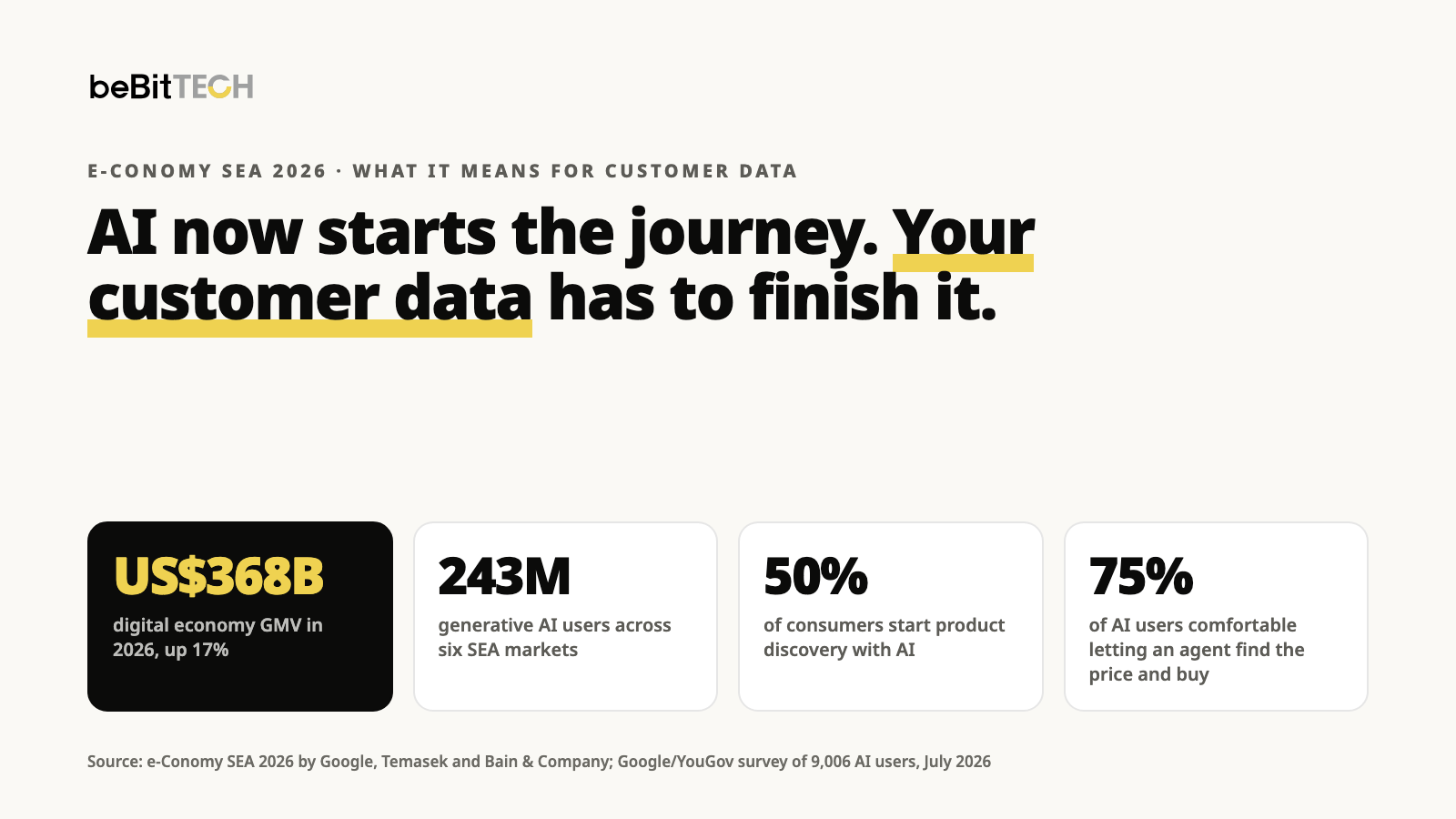
The e-Conomy SEA 2026 report by Google, Temasek and Bain & Company estimates that Southeast Asia's digital economy will reach US$368 billion in gross merchandise value in 2026, growing 17%, and is on course for US$1 trillion by 2035. The report names AI as the main accelerator and describes three changes in how people buy: AI is becoming the place where shopping starts, people trust it for bigger decisions, and many are ready to let an AI agent buy for them.
Google's advice to brands focuses on being found and chosen: content that AI can cite, AI-powered search campaigns, and product data that agents can read. That covers the moment before a customer arrives. This article covers what comes after: recognising the customer and keeping them. Those depend on first-party customer data, and the report's findings make that work more urgent.
The numbers that matter
The consumer figures below come from a Google and YouGov survey of 9,006 AI users across Southeast Asia, conducted in July 2026, as published with the report.
| Finding | Figure |
|---|---|
| Digital economy GMV in 2026 | US$368 billion, up 17% |
| Generative AI users in Indonesia, Malaysia, the Philippines, Singapore, Thailand and Vietnam | 243 million, used by 58% of the working population |
| Consumers who use AI for initial product discovery | 50% |
| Consumers who start shopping directly in a standalone AI app | 19% |
| Consumers who use AI to compare products | 69% |
| Users who research further after an AI recommendation | More than 90% |
| Consumers more confident in AI than a year ago | 62% |
| AI users comfortable letting an agent find the best price and buy | 75% |
Two of these matter most for customer data. Half of shoppers now start with AI, so the first question a customer asks often happens somewhere the brand cannot see. And more than nine in ten still check further before they buy, so the brand's own channels remain where the decision is confirmed.
Shift 1: AI is where discovery starts
When a shopper asks an AI assistant which air fryer or skincare routine suits them, the assistant hears the question. The brand sees only the visit that follows, if there is one. The intent, the products compared and the reason for choosing all stay in the conversation.
That makes everything that happens after arrival more valuable. What a visitor views, searches and adds to cart on your website or app is the only record of their interest that you own. It is also what lets you continue the conversation the AI started, instead of starting again from zero.
What this means for your customer data
- Capture behaviour as well as orders. Product views, searches and cart events should flow into the same profile as purchases, so you can act on interest before anyone buys.
- Tie visits to known customers. A behaviour record is worth far more once it is linked to a member ID, an email or a phone number.
- Label interests as they appear. Category, price band and product line tags turn a browsing session into a segment you can use the same day.
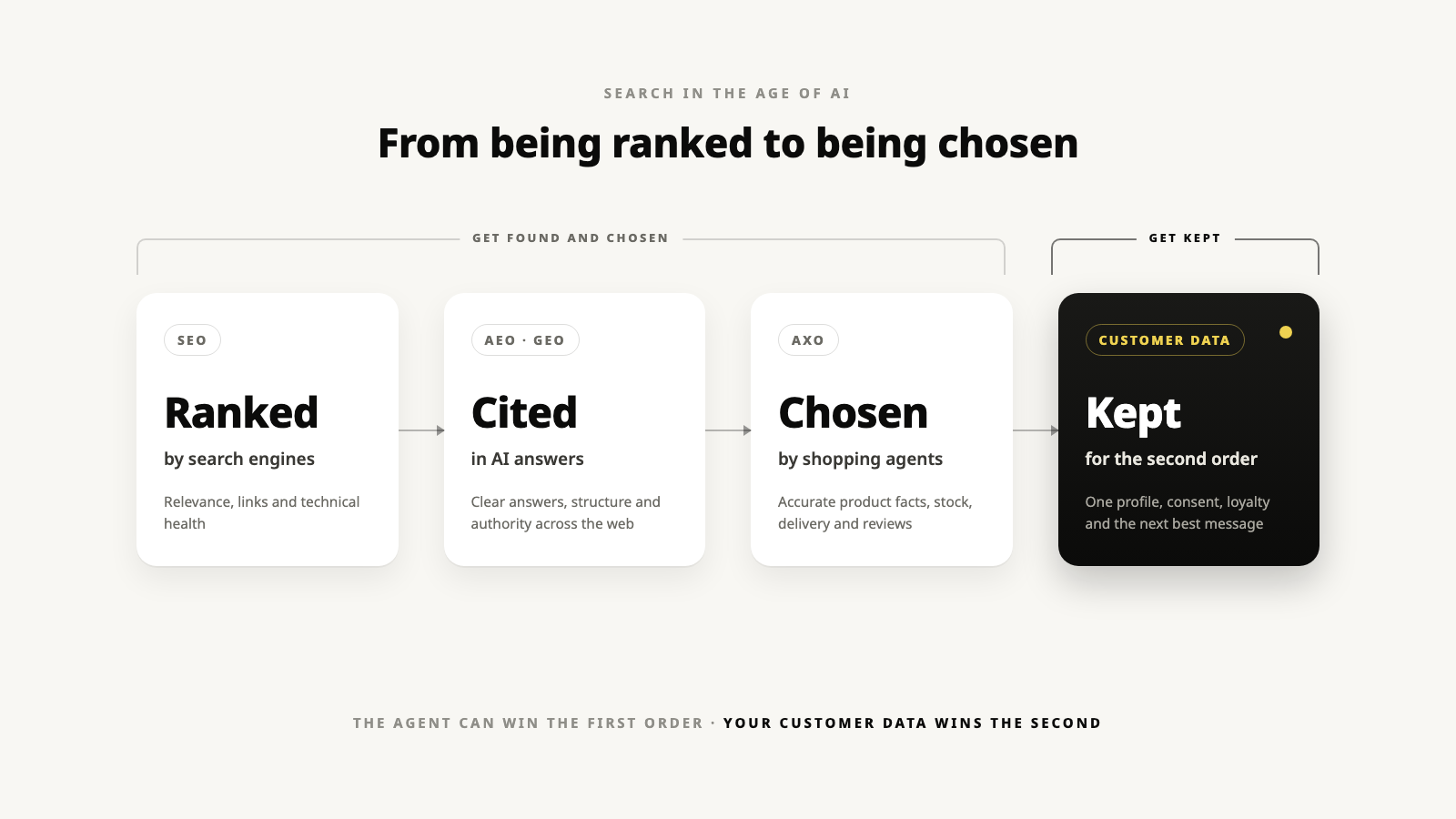
Our guide to GEO, AEO and AXO covers how to be the brand the AI recommends. The steps above make sure that recommendation turns into a relationship.
Shift 2: Trust moves to bigger decisions
The report finds people using AI for categories with technical detail or high price tags, such as electronics, infant care, jewellery and furniture. The report also sees AI used for discovery in financial services and travel. In all of these, the customer expects the brand to know them.
Trust earned by an AI recommendation is easy to lose afterwards. A shopper who was matched to the right product by an assistant, then receives the same generic promotion as everyone else, notices the gap. The follow-up has to be as relevant as the recommendation was.
What this means for your customer data
- Personalise after the first purchase. Recommendations, timing and channel should come from what this customer did.
- Respect the channel each person answers. Some customers read email, others answer WhatsApp. Choosing per person cuts wasted sends and the fatigue that erodes trust.
- In regulated industries, trust also means control. Banks and insurers need every journey approved, contact frequency capped and every send logged. See how this works for financial institutions.
Shift 3: Agents start to buy
Three in four AI users in the survey are comfortable letting an agent find the best price and complete the purchase, and 45% would let an agent make the decision within limits they set. The report also notes that guardrails and privacy protections need to be in place before this becomes mainstream.
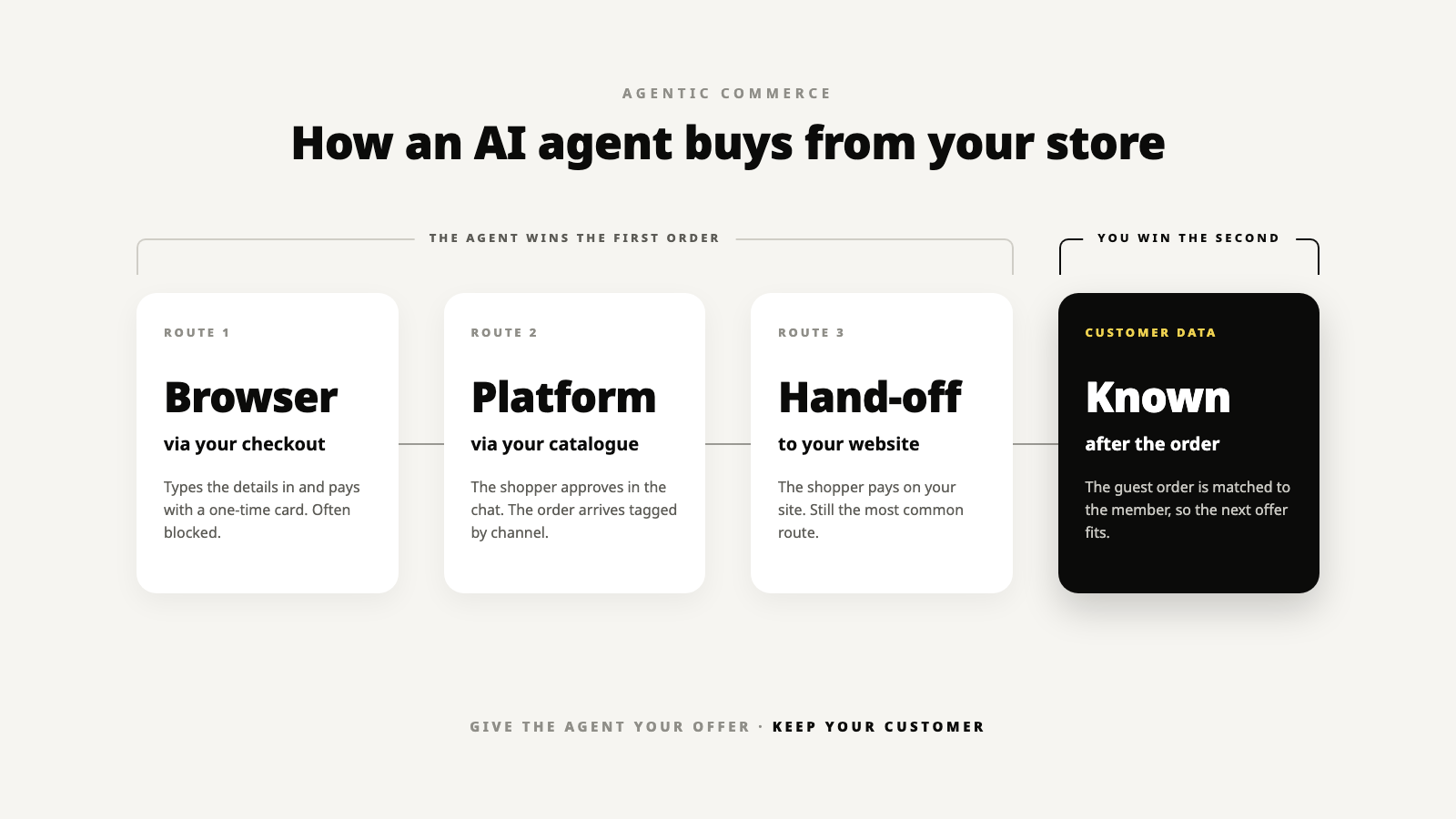
When an agent buys, the brand usually receives the order but not the conversation behind it, and often not the knowledge that the buyer is already a member. We explain the mechanics in how agentic commerce works. The short version: the agent can win the first order, and your customer data decides whether you win the second.
What this means for your customer data
- Recognise members behind agent orders. Match incoming orders to existing profiles by email, phone number or member ID, and collect verified contact details from members before agents arrive in volume.
- Share offers with agents, keep profiles in house. Price, stock and member benefits can go to an agent. The customer's history stays inside your own systems.
- Track AI as a source. Tag orders and sign-ups that come from AI channels, so AI-sourced customers become a segment you can measure and nurture.
What the report covers, and what it leaves to you
The report's recommendations are about visibility and media: be cited by AI, show up in AI-powered search, and make products easy for agents to read and buy. Each one has a customer-data counterpart that decides whether the customer stays.
| The report's recommended move | The customer-data side |
|---|---|
| Create content that AI models can find and cite | Capture what AI-referred visitors do once they land, and link it to a profile |
| Move from keyword campaigns to AI-powered search campaigns | Feed those campaigns with first-party audiences, such as high-value or lapsing customers |
| Adopt the Universal Commerce Protocol and keep product feeds complete | Recognise members in agent orders and follow up with membership, consent and the right add-on |
| Win trust with relevant, personalised experiences | Unify online, in-store and loyalty data so personalisation is based on the whole customer |
What to do in the next 12 months
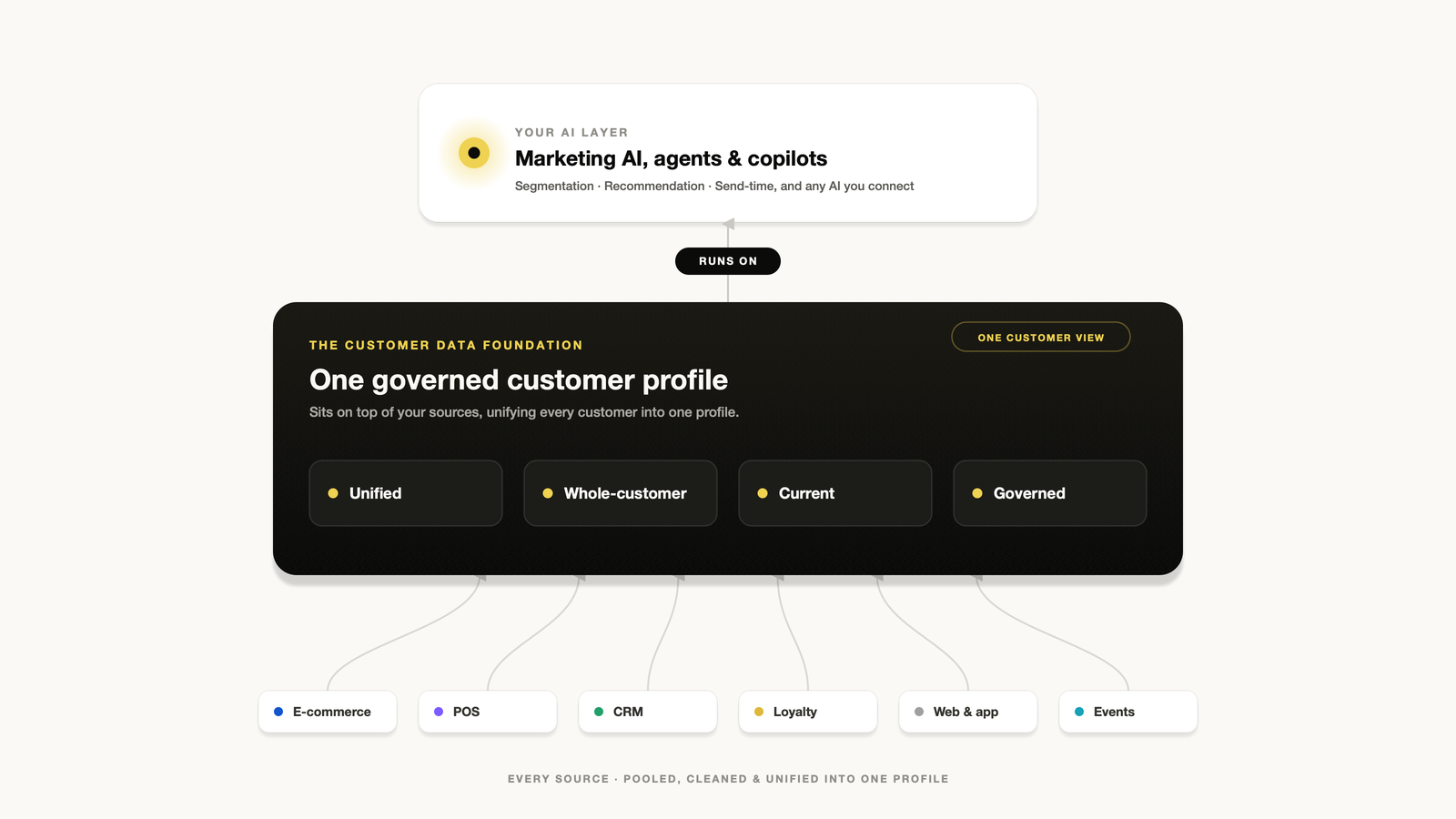
- Unify the customer first. Bring online orders, in-store purchases, app activity and loyalty records into one profile per person. Every other step depends on it.
- Collect verified contact details. Ask members for a phone number and email at every touchpoint, with consent recorded.
- Capture on-site behaviour. Track product views, searches and carts against the customer profile as well as in your analytics tool.
- Tag AI as a source. Record which customers arrive through AI assistants, AI search and agents.
- Build the follow-up journeys. A welcome journey for first-time buyers, a reorder reminder timed to each customer's buying cycle, and win-back for those who drift.
- Send first-party audiences to your ad campaigns. AI-powered campaigns work better when they know who your best customers are.
- Set the guardrails. Decide who approves journeys, how often a customer can be contacted, and what data an outside agent may receive.
Where OmniSegment fits
OmniSegment is a customer data platform built for this kind of work. One ID resolves online, in-store and loyalty records into a single profile. AI Segmentation finds the audience, AI Recommendation chooses what each person sees, and AI Sending picks the channel and the moment for each customer. AGENTBIT, available now in OmniSegment, lets marketers describe an audience or a journey in plain words.
Versuni, the home-appliance company, unified its offline and online data on OmniSegment and doubled its existing-customer repurchase rate, with online revenue up 55%. Read the full Versuni story.
Frequently asked questions
What is the e-Conomy SEA 2026 report?
It is the annual study of Southeast Asia's digital economy by Google, Temasek and Bain & Company. The 2026 edition estimates gross merchandise value of US$368 billion for the year, up 17%, and identifies AI as the main driver of growth toward US$1 trillion by 2035.
How are Southeast Asian consumers using AI to shop?
According to the report's survey of AI users, 50% use AI for initial product discovery, 69% use it to compare products, and 19% start shopping directly in a standalone AI app. More than 90% research further after an AI recommendation.
Are Southeast Asian consumers ready for agentic commerce?
Many are open to it. The survey found 75% of AI users comfortable letting an AI agent find the best price and buy, and 45% willing to let an agent make purchase decisions within set limits. The report adds that guardrails and privacy protections need to come first.
Why does first-party customer data matter more as AI grows?
Because AI assistants and agents hold the early part of the journey, including the question and the comparison. What a brand can still own is the customer's profile: their purchases, behaviour, preferences and consent. That profile is what lets a brand recognise the customer and serve them personally after the AI hands them over.
What is the Universal Commerce Protocol?
It is an open standard mentioned in the report that lets AI agents interact with a merchant's products and services, including checkout from eligible listings in Google's AI experiences.
Key takeaway
- Southeast Asia's digital economy is growing 17% in 2026 to US$368 billion, and the report credits AI as the main accelerator.
- Half of shoppers now start with AI, so the first question often happens where brands cannot see it.
- Rising trust in AI raises the bar for what comes after: generic follow-ups undo a good recommendation.
- Agents can win the first order. Unified, consented first-party data wins the second.